


Don’t let overlooked obligations become incidents. Learn how.
Utility navigation bar redirect icon
Portal LoginSupportContact
Search
Close search
Huntress Logo in Teal
  • Platform Overview
    Managed EDR

    Get full endpoint visibility, detection, and response.

    Managed EDR

    Get full endpoint visibility, detection, and response.

    Managed ITDR

    Protect your Microsoft 365 identities and email environments.

    Managed ITDR

    Protect your Microsoft 365 identities and email environments.

    Managed SIEM

    Managed threat response and robust compliance support at a predictable price.

    Managed SIEM

    Managed threat response and robust compliance support at a predictable price.

    Managed Security Awareness Training

    Empower your teams with science-backed security awareness training.

    Managed Security Awareness Training

    Empower your teams with science-backed security awareness training.

    Managed ISPM

    Continuous Microsoft 365 and identity hardening, managed and enforced by Huntress experts.

    Managed ISPM

    Continuous Microsoft 365 and identity hardening, managed and enforced by Huntress experts.

    Managed ESPM

    Proactively secure endpoints against attacks.

    Managed ESPM

    Proactively secure endpoints against attacks.

    Integrations
    Integrations
    Support Documentation
    Support Documentation
    See Huntress in Action

    Quickly deploy and manage real-time protection for endpoints, email, and employees - all from a single dashboard.

    Huntress Cybersecurity
    See Huntress in Action

    Quickly deploy and manage real-time protection for endpoints, email, and employees - all from a single dashboard.

    Huntress Cybersecurity
  • Threats We Stop
    Phishing
    Phishing
    Business Email Compromise
    Business Email Compromise
    Ransomware
    Ransomware
    Infostealers
    Infostealers
    View Allright arrowView Allright arrow
    Industries We Serve
    Education
    Education
    Financial Services
    Financial Services
    State and Local Government
    State and Local Government
    Healthcare
    Healthcare
    Law Firms
    Law Firms
    Manufacturing
    Manufacturing
    Utilities
    Utilities
    View Allright arrowView Allright arrow
    Tailored Solutions
    MSPs
    MSPs
    Resellers
    Resellers
    SMBs
    SMBs
    Compliance
    Compliance
    What Gets Overlooked Gets Exploited

    Most days, nothing happens. But one day, something will.

    Huntress Cybersecurity
    Cybercriminals Have Evolved

    Get the intel on today’s cybercriminal groups and learn how to protect yourself.

    Huntress Cybersecurity
  • Pricing
  • Community Series
    The Product Lab

    Shape the next big thing in cybersecurity together.

    The Product Lab

    Shape the next big thing in cybersecurity together.

    Fireside Chat

    Real people. Real perspectives. Better conversations.

    Fireside Chat

    Real people. Real perspectives. Better conversations.

    Tradecraft Tuesday

    No products, no pitches – just tradecraft.

    Tradecraft Tuesday

    No products, no pitches – just tradecraft.

    _declassified

    Exposing hidden truths in the world of cybersecurity.

    _declassified

    Exposing hidden truths in the world of cybersecurity.

    Resources
    Upcoming Events
    Upcoming Events
    Ebooks
    Ebooks
    On-Demand Webinars
    On-Demand Webinars
    Videos
    Videos
    Whitepapers
    Whitepapers
    Datasheets
    Datasheets
    Cybersecurity Education
    Cybersecurity 101
    Cybersecurity 101
    Cybersecurity Guides
    Cybersecurity Guides
    Threat Library
    Threat Library
    Real Tradecraft, Real Results
    Real Tradecraft, Real Results
    2026 Cyber Threat Report
    2026 Cyber Threat Report
    The Huntress Blog
    Huntress Lands on the Microsoft Marketplace
    Huntress Cybersecurity
    Huntress Lands on the Microsoft Marketplace
    Huntress Cybersecurity
    How Huntress & DEFCERT Are Streamlining CMMC Assessment Prep
    Huntress Cybersecurity
    How Huntress & DEFCERT Are Streamlining CMMC Assessment Prep
    Huntress Cybersecurity
    Live Hacking Into Microsoft 365 with Kyle Hanslovan
    Huntress Cybersecurity
    Live Hacking Into Microsoft 365 with Kyle Hanslovan
    Huntress Cybersecurity
  • Why Huntress

    Go beyond AI in the fight against today’s hackers with Huntress Managed EDR purpose-built for your needs

    Huntress Cybersecurity
    Why Huntress

    Go beyond AI in the fight against today’s hackers with Huntress Managed EDR purpose-built for your needs

    Huntress Cybersecurity
    The Huntress SOC

    24/7 Security Operations Center

    The Huntress SOC

    24/7 Security Operations Center

    Reviews

    Why businesses of all sizes trust Huntress to defend their assets

    Reviews

    Why businesses of all sizes trust Huntress to defend their assets

    Case Studies

    Learn directly from our partners how Huntress has helped them

    Case Studies

    Learn directly from our partners how Huntress has helped them

    Community

    Get in touch with the Huntress Community team

    Community

    Get in touch with the Huntress Community team

    Compare Huntress
    Bitdefender
    Bitdefender
    Blackpoint
    Blackpoint
    Breach Secure Now!
    Breach Secure Now!
    Crowdstrike
    Crowdstrike
    Datto
    Datto
    SentinelOne
    SentinelOne
    Sophos
    Sophos
    Compare Allright arrowCompare Allright arrow
  • HUNTRESS HUB

    Login to access top-notch marketing resources, tools, and training.

    Huntress Cybersecurity
    HUNTRESS HUB

    Login to access top-notch marketing resources, tools, and training.

    Huntress Cybersecurity
    Partners
    MSPs

    Join our partner community to deliver expert-led managed security.

    MSPs

    Join our partner community to deliver expert-led managed security.

    Resellers

    Partner program designed to grow your cybersecurity business.

    Resellers

    Partner program designed to grow your cybersecurity business.

    Tech Alliances

    Driving innovation through global technology Partnerships

    Tech Alliances

    Driving innovation through global technology Partnerships

    Microsoft Partnership

    A Level-Up for Your Business Security

    Microsoft Partnership

    A Level-Up for Your Business Security

  • Press Release
    Huntress Announces Collaboration with Microsoft to Strengthen Cybersecurity for Businesses of All Sizes
    Huntress Cybersecurity
    Press Release
    Huntress Announces Collaboration with Microsoft to Strengthen Cybersecurity for Businesses of All Sizes
    Huntress Cybersecurity
    Our Story

    We're on a mission to shatter the barriers to enterprise-level security.

    Our Story

    We're on a mission to shatter the barriers to enterprise-level security.

    Newsroom

    Explore press releases, news articles, media interviews and more.

    Newsroom

    Explore press releases, news articles, media interviews and more.

    Meet the Team

    Founded by former NSA Cyber Operators. Backed by security researchers.

    Meet the Team

    Founded by former NSA Cyber Operators. Backed by security researchers.

    Careers

    Ready to shake up the cybersecurity world? Join the hunt.

    Careers

    Ready to shake up the cybersecurity world? Join the hunt.

    Awards
    Awards
    Contact Us
    Contact Us
  • Portal Login
  • Support
  • Contact
  • Search
  • Get a Demo
  • Start for Free
Portal LoginSupportContact
Search
Close search
Get a Demo
Start for Free
HomeBlog
Credential Theft: From Initial Access to Lateral Movement
Published:
April 8, 2025

Credential Theft: From Initial Access to Lateral Movement

By:
Huntress Adversary Tactics
Share icon
Glitch effectGlitch effectGlitch effect


What is credential theft? 


At its core, credential theft is the unauthorized acquisition of login credentials such as usernames, passwords, or session tokens by a malicious threat actor. Threat actors use different means to steal credentials. To steal credentials from a user or endpoint usually requires threat actors to achieve some form of initial access, and this can be done via phishing, brute force, or some other means. Once on an endpoint, threat actors want to extend their reach by obtaining credentials for accounts with greater privileges, or just additional credentials, which can then allow them to reach into other endpoints on the network, moving laterally.


Credential theft: Initial access phase 

One means of gaining initial access into endpoints is via phishing; that is, sending a user an email, hoping that the malicious content makes it to the user, and they access that content, as illustrated in Figure 1. This may provide the threat actor with a backdoor into the endpoint, or with the user’s credentials, or some other means of access.


Figure 1: Example of phishing email masquerading as a message from Docusign

Another means of gaining access to endpoints used by threat actors is SEO poisoning and malicious Google ads. Threat actors will look for software packages that users, and in particular system administrators, are searching for and will want to download. Then, they will package that software, which is often a free download, with their malware, and offer it up when someone searches for it. Once it’s downloaded, the user installs the legitimate software they were expecting, but also gets a little surprise they weren’t expecting, one that provides access to the threat actor.

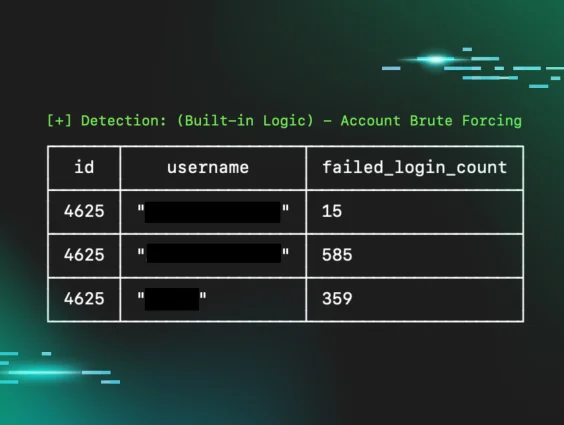
Another potential means of initial access is the use of vulnerabilities to exploit accessible services, or by brute force guessing passwords where authentication is required. One example of a vulnerable service was the FOUNDATION accounting software; in this instance, the purpose and use of the software required that it be publicly accessible, and the vulnerability to the software was that embedded credentials became known. A recent vulnerability in the mJobTime application highlights the risks of a 'hidden attack surface.' Specifically, a blind SQL injection flaw was identified, creating a significant security concern for on-site operations.

Other examples include Remote Desktop Protocol (RDP) and MSSQL server; if these services are exposed and publicly accessible, you can guarantee that at some point, someone (or several someones!!) is going to attempt to gain access via brute force password guessing attacks. This is why it’s important that administrators collect an accurate asset inventory (of systems and applications), and perform attack surface reduction. That way, if a service or application must be running, then it can be configured beyond the defaults to log the appropriate activity so that administrators can quickly respond to brute force attacks. 

Credential theft: Post-exploitation activity

Once a threat actor has gained access to an endpoint, either through phishing or brute force, one means of stealing additional credentials is through the use of infostealers, which according to the recent Huntress 2025 Cyber Threat Report and shown in Figure 2, made up nearly a quarter of the threats across all observed incidents.

Figure 2: Frequency of threats, as observed by Huntress analysts

Another means of gaining access to credentials is to run freely available password recovery tools. Administrators may be observed running one or two such tools, in an attempt to assist a user or troubleshoot an issue, but threat actors are more often observed running several such tools in sequence, often via a batch file or script of some kind. In one incident, Huntress analysts observed a threat actor running the batch file !start.cmd, the first line of which contained the following command:

mode  con: cols=50 lines=30

This command is used to configure the output to the console, and may not be something that’s observed in regular usage within many organizations. As such, it is provided here as it offers an excellent detection opportunity. Following this line, the batch file ran almost a dozen freely available password recovery tools, including (but not limited to) BulletsPassView, Dialupass, RouterPassView, and WebBrowserPassView. Threat actors may take this “shotgun” approach in an attempt to collect credentials from as many sources as possible, accepting that some may not bear fruit. Or, they may target specific content, attempting to copy off the password stores of specific browsers or other applications known to be in use on the endpoint.

Perhaps one of the most popular and well-known means of collecting credentials from an endpoint once a threat actor has gained access is to run Mimikatz, a freely available open-source tool used to gain access to credentials. Huntress SOC analysts have observed Mimikatz being used during a number of incidents, usually as a result of the threat actor’s use of the tool being detected, leading to quick isolation and remediation of the incident.

Credential theft via Registry hive dumps

A means of obtaining credentials for local accounts on the endpoint is through the use of native utilities, also known as “living off the land binaries” or “LOLBins.” One such utility is reg.exe, which allows administrators to interact with the Registry hives. This utility can be used to “dump” or save copies of the Registry hive files, via a command line such as the following:

reg.exe save hklm\system <path>

This command is then repeated for the Software and SAM Registry hives. Huntress sees a good bit of this activity delivered via lateral movement through the Impacket tool set, but these commands can also be run locally on the endpoint, via command prompt or PowerShell. This is likely due to the fact that the tool set is freely available, and the capability for running such commands across the network is built in, obviating the need to come up with your own means for credential theft. 

Huntress analysts have seen other means for collecting Registry hive files. In one incident, the threat actor connected to the endpoint from a previously observed, known malicious workstation via PSExec and ran the following command: 

"cmd" /c mklink /D C:\perflogs\Shadowcopy \\?\GLOBALROOT\Device\HarddiskVolumeShadowCopy102\

This command had not been preceded by a command to create a Volume Shadow Copy (VSC), but was instead preceded by a command to list the available VSCs. Attackers often abuse this legitimate Windows feature by creating VSCs to access Registry hives, so seeing this other technique is notable. The threat actor was then observed copying the Registry hives to their “ops folder:”

"cmd" /c copy C:\perflogs\Shadowcopy\Windows\System32\config\System C:\perflogs

As observed previously, these commands are then repeated for the Software and SAM Registry hives. Once obtained, a threat actor can run these Registry hives through a password cracking utility, such as Mimikatz or L0phtCrack, to obtain password hashes and perform dictionary and brute force password cracking attacks.

Other techniques

Another way to obtain the necessary information to conduct password-cracking attacks is to use various techniques to identify the Local Security Authority Subsystem Service (LSASS) process and dump the contents of process memory using a command line similar to the following:

%COMSPEC% /Q /c CMd.exE /Q /c for /f ""tokens=1,2 delims= "" ^%A in ('""tasklist /fi ""Imagename eq lsass.exe"" , find ""lsass""""') do rundll32.exe C:\windows\System32\comsvcs.dll, #+0000^24 ^0 \Windows\Temp\u3yb.sql

The above command line uses tasklist.exe to locate the LSASS process and then use the native comsvcs.dll to dump the process memory. An example of another, similar process being detected appears in Figure 3.


Figure 3: Process detection

To make this entire process easier and avoid having to crack password hashes, threat actors can “enable WDigest” using the following command line:

reg.exe add
HKLM\SYSTEM\CurrentControlSet\Control\SecurityProviders\WDigest /v
UseLogonCredential /t REG_DWORD /d 1 /f

This command modifies the Windows Registry and tells the operating system to store credentials in plain text, rather than encrypting them. Setting this Registry value, and then returning to the endpoint some time later—perhaps several days—allows the threat actor to collect credentials in plain text, obviating the time it takes to crack passwords. This is an approach that Huntress analysts have observed previously, and has been observed used in combination with other techniques.

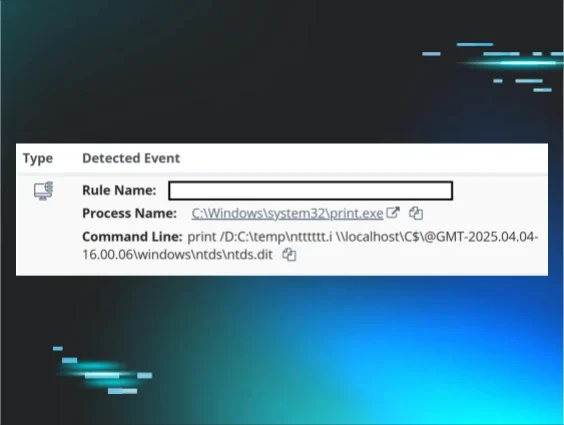
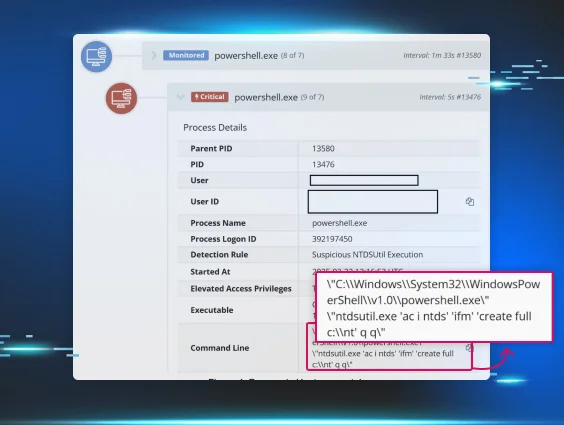
In order to obtain Active Directory credentials, threat actors will target domain controllers and attempt to obtain a copy of the NTDS.DIT file by using a command line similar to the following:

ntdsutil  "ac in ntds" "ifm" "cr fu "<path>\ntds.dit" " q q

An example of another iteration of this command in the Huntress portal, along with it’s process parent, can be seen in Figure 4.

Figure 4: Process in Huntress portal

A similar approach to the one noted above—copying files from a Volume Shadow Copy—has also been observed with respect to the NTDS.DIT file.

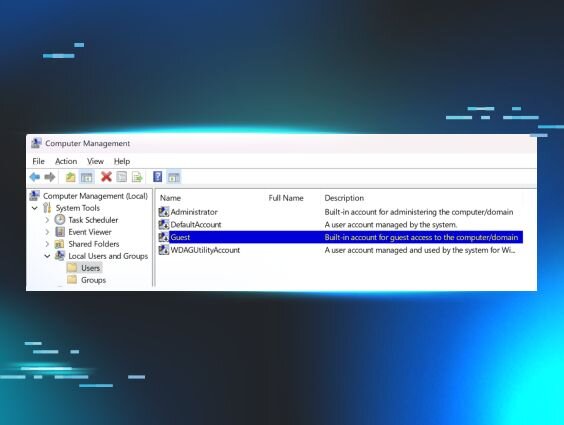
Finally, it’s not unusual for threat actors to employ multiple means of credential theft. In a recent incident, Huntress analysts observed the threat actor accessing an endpoint via a previously compromised account. The threat actor then enabled the Guest account, added a new account to the endpoint, ran Mimikatz, and then installed Grzegorz Tworek's NPPSpy, configuring the endpoint for a “man in the middle” attack to collect plain text passwords. 


Conclusion

In order to inhibit or even obviate a threat actor’s activities, it’s important to detect and respond to them as early in the attack cycle as possible. One way to do this is to understand what a threat actor’s activities might “look like” and understand ways in which these activities might be addressed. For example, organizations can look to security awareness training to address phishing attacks. And they can create an accurate asset inventory, and then follow that with attack surface reduction in order to address other types of attacks. Once these steps have been taken, organizations should strongly consider monitoring for unusual activity and changes to endpoints.  



Categories
Cybersecurity Education
Summarize this postClose Speech Bubble
ChatGPTClaudePerplexityGoogle AI

See Huntress in action

Our platform combines a suite of powerful managed detection and response tools for endpoints and Microsoft 365 identities, science-backed security awareness training, and the expertise of our 24/7 Security Operations Center (SOC).

Book a Demo
Share
Facebook iconTwitter X iconLinkedin iconDownload icon
Glitch effect

You Might Also Like

  • Brute Force or Something More? Ransomware Initial Access Brokers Exposed

    Discover how a seemingly simple brute force attack led to the uncovering of a suspected ransomware-as-a-service operation. This ecosystem appears to be leveraged by initial access brokers, driving an illicit and complex network of cybercrime.
  • Unwanted Access: Protecting Against the Growing Threat of Session Hijacking and Credential Theft

    Discover how our new Unwanted Access capability strengthens your defenses against session hijacking and credential theft. Dive in and learn how to minimize risks and protect your business-critical assets from evolving cyber threats.
  • Credential Theft: Expanding Your Reach, Pt. II

    As with many tactics within the MITRE ATT&CK framework, credential theft consists of a number of different techniques. Showing what many of them look like on an endpoint helps other security professionals understand what to look for and how to detect and respond to similar activity.
  • Sector Spotlight: Threats Plaguing Education

    Threat actors are targeting the education sector with data breaches, phishing emails, ransomware hits, brute force RDP attacks, and more.
  • Analyzing Initial Access Across Today's Business Environment

    Learn more about the initial access techniques observed by the Huntress SOC and Tactical Response teams! Gain valuable insights to help you protect your environment.
  • Why Persistence Is a Staple for Today’s Hackers

    Learn how hackers use persistence to gain—and keep—access to your virtual environments.
  • The Unwanted Guest

    Threat actors are enabling the built-in Windows Guest account to maintain persistence. Learn how they gain access and how to detect this activity.
  • Data Exfiltration and Threat Actor Infrastructure Exposed

    Threat actors are people, too, and like everyone else, make mistakes. These mistakes can reveal insights into the threat actor, or even expose access to their infrastructure.

Sign Up for Huntress Updates

Get insider access to Huntress tradecraft, killer events, and the freshest blog updates.
Privacy • Terms
By submitting this form, you accept our Terms of Service & Privacy Policy
Thank you! Your submission has been received!
Oops! Something went wrong while submitting the form.
Huntress Managed Security PlatformManaged EDRManaged EDR for macOSManaged EDR for LinuxManaged ITDRManaged SIEMManaged Security Awareness TrainingManaged ISPMManaged ESPMBook a Demo
PhishingComplianceBusiness Email CompromiseEducationFinanceHealthcareManufacturingState & Local Government
Managed Service ProvidersResellersIT & Security Teams24/7 SOCCase Studies
BlogResource CenterCybersecurity 101Upcoming EventsSupport Documentation
Our CompanyLeadershipNews & PressCareersContact Us
Huntress white logo

Protecting 215k+ customers like you with enterprise-grade protection.

Privacy PolicyCookie PolicyTerms of UseCookie Consent
Linkedin iconTwitter X iconYouTube iconInstagram icon
© 2025 Huntress All Rights Reserved.

Join the Hunt

Get insider access to Huntress tradecraft, killer events, and the freshest blog updates.

By submitting this form, you accept our Terms of Service & Privacy Policy