





Don’t let overlooked obligations become incidents. Learn how.
Utility navigation bar redirect icon
Portal LoginSupportContact
Search
Close search
Huntress Logo in Teal
  • Platform Overview
    Managed EDR

    Get full endpoint visibility, detection, and response.

    Managed EDR

    Get full endpoint visibility, detection, and response.

    Managed ITDR

    Protect your Microsoft 365 identities and email environments.

    Managed ITDR

    Protect your Microsoft 365 identities and email environments.

    Managed SIEM

    Managed threat response and robust compliance support at a predictable price.

    Managed SIEM

    Managed threat response and robust compliance support at a predictable price.

    Managed Security Awareness Training

    Empower your teams with science-backed security awareness training.

    Managed Security Awareness Training

    Empower your teams with science-backed security awareness training.

    Managed ISPM

    Continuous Microsoft 365 and identity hardening, managed and enforced by Huntress experts.

    Managed ISPM

    Continuous Microsoft 365 and identity hardening, managed and enforced by Huntress experts.

    Managed ESPM

    Proactively secure endpoints against attacks.

    Managed ESPM

    Proactively secure endpoints against attacks.

    Integrations
    Integrations
    Support Documentation
    Support Documentation
    See Huntress in Action

    Quickly deploy and manage real-time protection for endpoints, email, and employees - all from a single dashboard.

    Huntress Cybersecurity
    See Huntress in Action

    Quickly deploy and manage real-time protection for endpoints, email, and employees - all from a single dashboard.

    Huntress Cybersecurity
  • Threats We Stop
    Phishing
    Phishing
    Business Email Compromise
    Business Email Compromise
    Ransomware
    Ransomware
    Infostealers
    Infostealers
    View Allright arrowView Allright arrow
    Industries We Serve
    Education
    Education
    Financial Services
    Financial Services
    State and Local Government
    State and Local Government
    Healthcare
    Healthcare
    Law Firms
    Law Firms
    Manufacturing
    Manufacturing
    Utilities
    Utilities
    View Allright arrowView Allright arrow
    Tailored Solutions
    MSPs
    MSPs
    Resellers
    Resellers
    SMBs
    SMBs
    Compliance
    Compliance
    What Gets Overlooked Gets Exploited

    Most days, nothing happens. But one day, something will.

    Huntress Cybersecurity
    Cybercriminals Have Evolved

    Get the intel on today’s cybercriminal groups and learn how to protect yourself.

    Huntress Cybersecurity
  • Pricing
  • Community Series
    The Product Lab

    Shape the next big thing in cybersecurity together.

    The Product Lab

    Shape the next big thing in cybersecurity together.

    Fireside Chat

    Real people. Real perspectives. Better conversations.

    Fireside Chat

    Real people. Real perspectives. Better conversations.

    Tradecraft Tuesday

    No products, no pitches – just tradecraft.

    Tradecraft Tuesday

    No products, no pitches – just tradecraft.

    _declassified

    Exposing hidden truths in the world of cybersecurity.

    _declassified

    Exposing hidden truths in the world of cybersecurity.

    Resources
    Upcoming Events
    Upcoming Events
    Ebooks
    Ebooks
    On-Demand Webinars
    On-Demand Webinars
    Videos
    Videos
    Whitepapers
    Whitepapers
    Datasheets
    Datasheets
    Cybersecurity Education
    Cybersecurity 101
    Cybersecurity 101
    Cybersecurity Guides
    Cybersecurity Guides
    Threat Library
    Threat Library
    Real Tradecraft, Real Results
    Real Tradecraft, Real Results
    2026 Cyber Threat Report
    2026 Cyber Threat Report
    The Huntress Blog
    Huntress Lands on the Microsoft Marketplace
    Huntress Cybersecurity
    Huntress Lands on the Microsoft Marketplace
    Huntress Cybersecurity
    How Huntress & DEFCERT Are Streamlining CMMC Assessment Prep
    Huntress Cybersecurity
    How Huntress & DEFCERT Are Streamlining CMMC Assessment Prep
    Huntress Cybersecurity
    Live Hacking Into Microsoft 365 with Kyle Hanslovan
    Huntress Cybersecurity
    Live Hacking Into Microsoft 365 with Kyle Hanslovan
    Huntress Cybersecurity
  • Why Huntress

    Go beyond AI in the fight against today’s hackers with Huntress Managed EDR purpose-built for your needs

    Huntress Cybersecurity
    Why Huntress

    Go beyond AI in the fight against today’s hackers with Huntress Managed EDR purpose-built for your needs

    Huntress Cybersecurity
    The Huntress SOC

    24/7 Security Operations Center

    The Huntress SOC

    24/7 Security Operations Center

    Reviews

    Why businesses of all sizes trust Huntress to defend their assets

    Reviews

    Why businesses of all sizes trust Huntress to defend their assets

    Case Studies

    Learn directly from our partners how Huntress has helped them

    Case Studies

    Learn directly from our partners how Huntress has helped them

    Community

    Get in touch with the Huntress Community team

    Community

    Get in touch with the Huntress Community team

    Compare Huntress
    Bitdefender
    Bitdefender
    Blackpoint
    Blackpoint
    Breach Secure Now!
    Breach Secure Now!
    Crowdstrike
    Crowdstrike
    Datto
    Datto
    SentinelOne
    SentinelOne
    Sophos
    Sophos
    Compare Allright arrowCompare Allright arrow
  • HUNTRESS HUB

    Login to access top-notch marketing resources, tools, and training.

    Huntress Cybersecurity
    HUNTRESS HUB

    Login to access top-notch marketing resources, tools, and training.

    Huntress Cybersecurity
    Partners
    MSPs

    Join our partner community to deliver expert-led managed security.

    MSPs

    Join our partner community to deliver expert-led managed security.

    Resellers

    Partner program designed to grow your cybersecurity business.

    Resellers

    Partner program designed to grow your cybersecurity business.

    Tech Alliances

    Driving innovation through global technology Partnerships

    Tech Alliances

    Driving innovation through global technology Partnerships

    Microsoft Partnership

    A Level-Up for Your Business Security

    Microsoft Partnership

    A Level-Up for Your Business Security

  • Press Release
    Huntress Announces Collaboration with Microsoft to Strengthen Cybersecurity for Businesses of All Sizes
    Huntress Cybersecurity
    Press Release
    Huntress Announces Collaboration with Microsoft to Strengthen Cybersecurity for Businesses of All Sizes
    Huntress Cybersecurity
    Our Story

    We're on a mission to shatter the barriers to enterprise-level security.

    Our Story

    We're on a mission to shatter the barriers to enterprise-level security.

    Newsroom

    Explore press releases, news articles, media interviews and more.

    Newsroom

    Explore press releases, news articles, media interviews and more.

    Meet the Team

    Founded by former NSA Cyber Operators. Backed by security researchers.

    Meet the Team

    Founded by former NSA Cyber Operators. Backed by security researchers.

    Careers

    Ready to shake up the cybersecurity world? Join the hunt.

    Careers

    Ready to shake up the cybersecurity world? Join the hunt.

    Awards
    Awards
    Contact Us
    Contact Us
  • Portal Login
  • Support
  • Contact
  • Search
  • Get a Demo
  • Start for Free
Portal LoginSupportContact
Search
Close search
Get a Demo
Start for Free
HomeBlog
Behind the Scenes: Crushing Cybercriminals with MAV
Published:
July 21, 2022

Behind the Scenes: Crushing Cybercriminals with MAV

By:
Matt Anderson
Share icon
Glitch effectGlitch effectGlitch effect

At Huntress, we see a great deal of intrusions and share attack data with the community as we can. Today, we’ll highlight how Microsoft Defender and multiple services (namely Managed Microsoft Defender, Process Insights and Open Port Detection) enabled the Huntress team to identify threats in near real-time.

In our webinar How to Crush Cybercriminals with Managed Antivirus, we explored the technical highlights of an intrusion via a public-facing SQL server. Now we’d like to dive in and discuss some additional pieces of the incident and share some of what we learned. 

Scoping the Intrusion

To begin, let’s recount the attack sequence at a high level: 

  • A remote IPv4 address bruteforced an internet-facing SQL service
  • The threat actor downloaded a malicious batch script to the system 
  • The threat actor began enumerating the network
  • Huntress responded to the attack and isolated the system

Huntress ThreatOps Center Powers the Investigation

We often begin threat analysis as threaded conversations so we can keep the narrative of an attack in one place. This helps the team stay organized and creates a chronological record of how the investigation unfolds.

image11

Then, we start collaborating together from the beginning and work together not only to investigate the incident but communicate between teams efficiently. Then, we get to work in the thread:

image3

There’s a lot going on in this screenshot! Acronyms, internal code names and indicators of compromise! Let’s unpack this.

  • MAV is Managed Antivirus—how Huntress leverages Microsoft Defender to get granular security alerts  
  • Rio is the legacy internal name for our EDR agent, Process Insights

Microsoft Defender was our initial signal that a threat actor had access to the system. The Microsoft Defender alert identified Meterpreter: a hacking tool often used to create malicious callback stagers that allows threat actors interactive remote access to a system. A quick pivot from a Managed Antivirus alert to the Process Insights EDR data revealed the threat actor downloaded a .txt file containing a malicious script.

The information in the screenshot below helped us demystify this further, showing the original alert we received from our Microsoft Defender Managed Antivirus service.
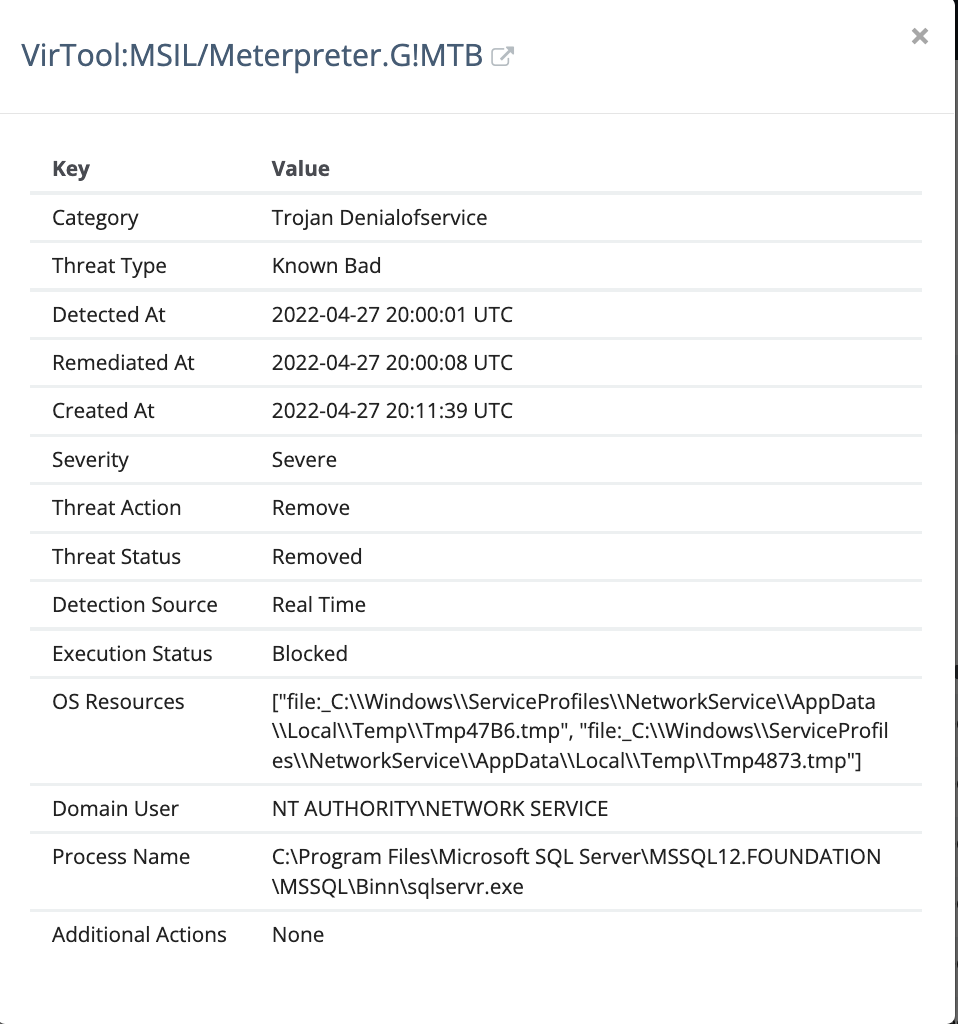
image4

This alert triggered us to investigate further using our Process Insights EDR to dig into executing processes on the system:

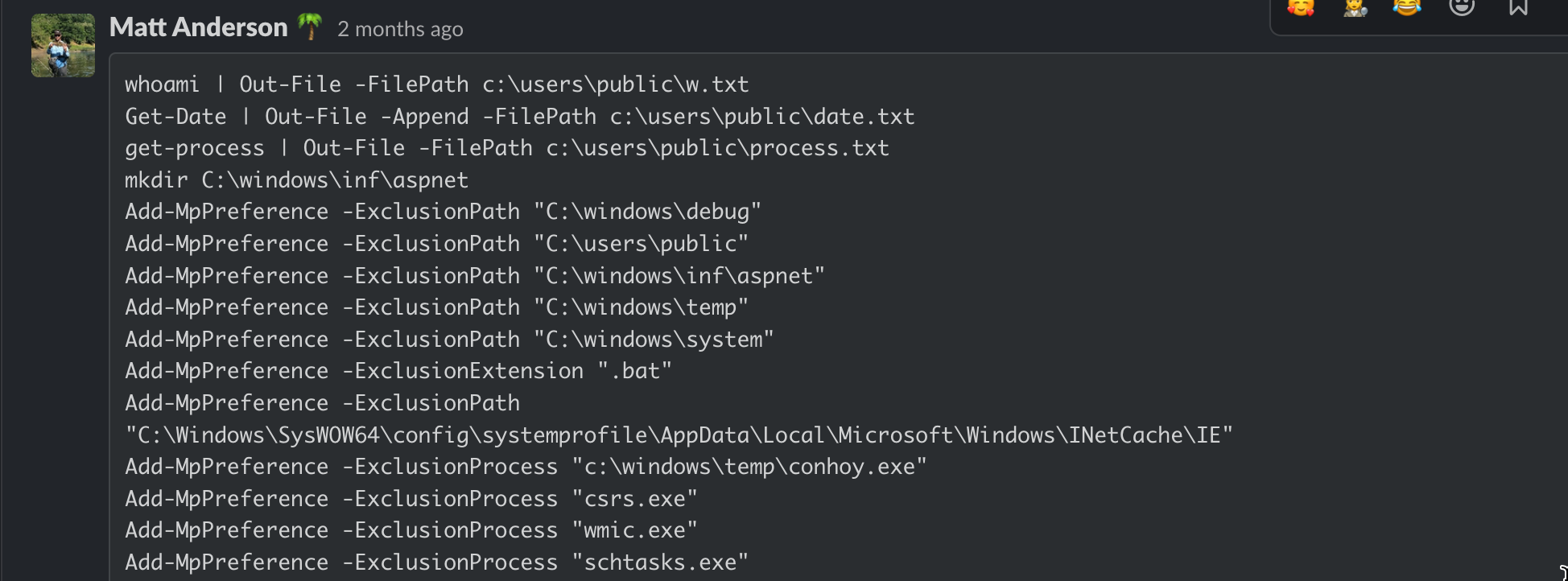
image2
image8

The screenshot above lays out the contents of the malicious batch script downloaded by the threat actor. A large portion of the above commands perform defense evasion techniques by adding exclusions to Defender for various file paths, extensions and process names.

Our security research team had the following response to this script:
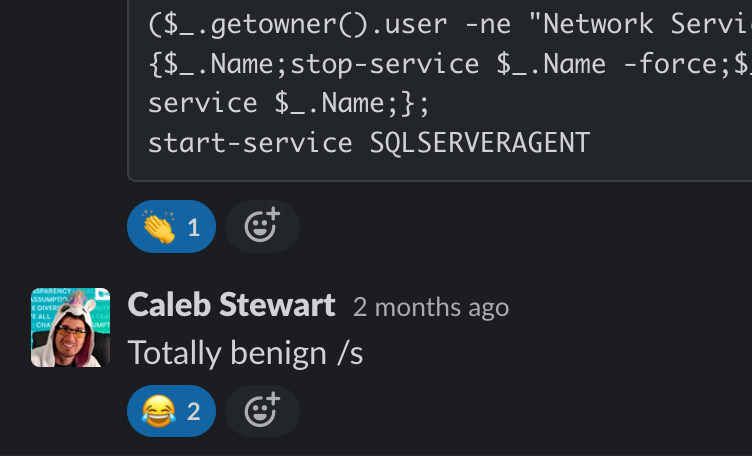
image1

It’s pretty easy to see the malicious intent here, based on the number and location of the directories (many that are commonly used to store and execute malware from) and file extensions that were set to be excluded from Microsoft Defender to avoid being spotted and removed. They wanted no part of Defender meddling with their files.

This highlights the fact that threat actors often try to disable, blind or weaken the ability of any antivirus software to do its job, and demonstrates the importance of monitoring things like Exclusion paths and limiting the number of exclusions set to make it much harder on the threat actor to get away with this type of activity.

The team next discovered that port 1433 was open for public scanning via External Recon, our platform feature that offers visibility into internet-exposed services and devices that are present in an organization. 
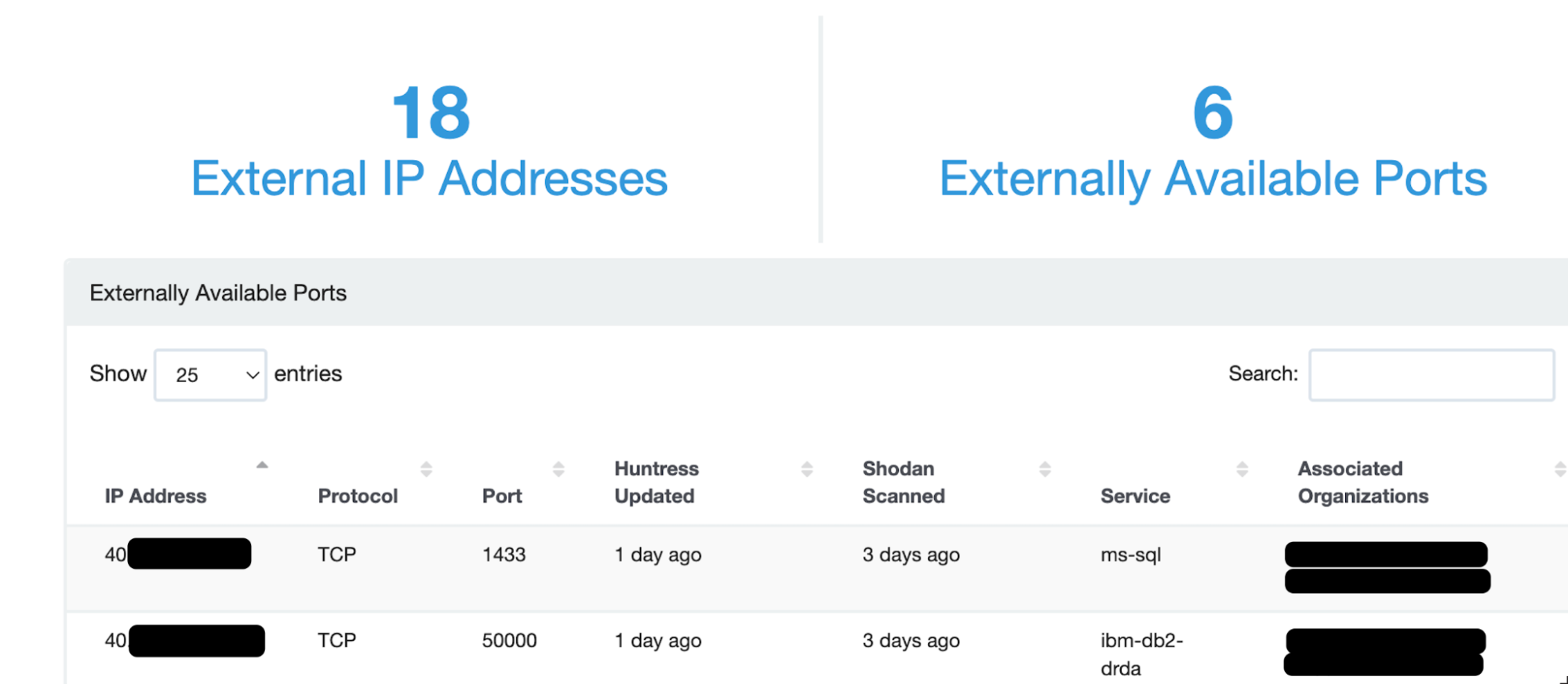
image6

Whenever we detect an intrusion, External Recon is often where we look first to find a potential initial access vector. The easy way is often the actual way, so if a common port is exposed to the internet for all manners of scanning and probing for vulnerabilities or weak passwords for services protected by single-factor authentication, this presents a strong possibility for how the threat actor entered the network. 

Once we understand how a threat actor gained initial access, we’re able to forecast other potential pieces of the puzzle—something we recently discussed during a Tradecraft Tuesday episode—and direct our attention to specific forensic artifacts that are likely to tell the next part of the story.

In this case, the SQL server logs were of interest if this server did actually provide the initial access vector to the network. When we looked at the logs, they appeared to tell the story that we expected, of brute forcing (repeated failed logins from IP addresses in foreign countries) the authentication method to gain entry into the server. With the evidence found here to confirm our initial suspicions of access via the internet-exposed SQL server (port 1433), we can move on to the next piece to further clarify the full picture of this intrusion.  

image5

Thanks to Microsoft Defender detecting and alerting us to this activity, we were able to assemble the team to investigate it further. Quickly pivoting to additional telemetry from the Process Insights EDR, External Recon, a little open-source intelligence, a few forensic artifacts and some malware analysis, we were able to round out the investigation.  

We determined that it was malicious, and promptly provided the necessary remediation actions on the report sent to the partner to squash this activity and evict this threat actor before the incident escalated any further.

Post-Mortem Learning Opportunities

Now that we’ve fully explored the active investigation component, we can start moving toward post-mortem actions. We always want to use any incident that occurs as a learning opportunity for us, our partners and the community whenever we can, and this incident provided opportunities for all three.

Opportunity  #1: Educating Our Partners 

Our Security Engineering team is critical as the technical interface for many partners. They, along with our Partner Success and Product Support teams, do a great job of translating analyst findings and reports into actionable, conversational pieces with partners.
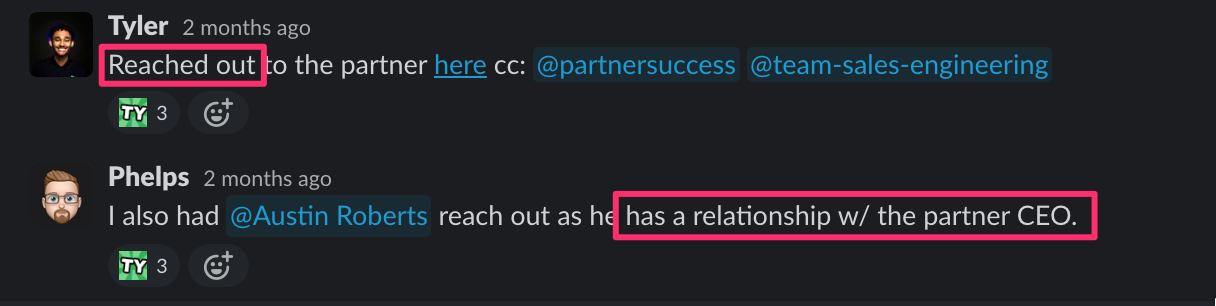
image7

Our Product Support team is also always quick to jump in and start the conversation with a partner when needed, as well as relaying critical information back to analysts if the partner has more questions and more information to provide to us to aid in our analysis.  

In this instance, like many others, one of our security engineers gains a better understanding of the organization’s security posture (internet-exposed ports, insecure server authentication methods, lack of monitoring authentication and other server logs, possible Antivirus misconfigurations, etc.) that may have led to the incident, and can offer additional recommendations to increase their overall security posture and minimize the impact of or even prevent a future incident.

Opportunity #2: Educating Ourselves 

We often learn from incidents ourselves as we see new attacks for the first time. Director of ThreatOps Max Rogers regularly says that attackers don’t like to change their behaviors. Instead, they prefer to drop their malware in the same directories during their intrusions (often with similar file names and identical processes/impact) or even use playbooks with the exact same procedures each time they carry out an attack

This means that writing down ideas for detections and collaborating with our Detection Engineering team is a critical part of the feedback loop from any investigation or incident. Any time we see a new behavior, we immediately begin looking for ways to detect it in the future. Then our Detection Engineers can create a new Detector to make our response even faster the next time, as well as continually test the efficacy and reliability of our automated alerting.

image9

Opportunity #3: Educating the Community

At this point, we’re ready to share our findings to help the community as a whole learn as much as we did during an investigation.

We rely on our Marketing team to help us with that task:

image10-1

We love sharing interesting cases and content, but even more than that we love sharing useful information that can directly benefit the community, making life easier for SMBs and those that help secure them. This incident provides a good opportunity to do just that—as this was specific behavior that, if detected, is very likely to be malicious.  

Other recent articles, such as one by the DFIR Report, note an increase of attacks against SQL servers recently, so monitoring login attempts of public-facing servers as well as the behavior occurring on these servers is critical. Collecting telemetry from servers and endpoints in your network is just the first step, however, and having a method for analyzing the telemetry is just as important.

One way to do this is by using Sigma rules to look for signs of malicious behavior. Sigma is a generic format for writing signatures to analyze various log files, like Windows Event Logs, for example, which can be used across a wide variety of platforms and tools. 

This Sigma rule will detect the malicious behavior that occurred in this incident:

It's very specific to the threat we saw and should result in very few false positives, but because it is very specific, you may need additional rules to catch other malicious activity using the SQLPS module or other similar SQL modules that can be misused for evil. 

Learn More

If you take away anything from this blog (other than the above Sigma rule, of course), I hope it’s this:

At Huntress, we will viciously tear apart every intrusion, leveraging every source of telemetry we can get our hands on. We will pivot from data source to data source—whether that’s Managed Antivirus alerts, or Process Insights EDR data, or the forensics artifacts on a machine—and we’ll leverage as many contextual parameters as we can, like External Recon, to provide threads of evidence that allow us to weave together a cohesive account of the adversarial campaign and report it back to our partner with actionable recommendations.

In this case, Managed Microsoft Defender (previously known as Managed Antivirus) tipped us off and piqued our curiosity, but it took a combination of Process Insights, Open Port Detection, and malicious tooling left on the host to truly illuminate this attack.


Categories
Threat Analysis
Summarize this postClose Speech Bubble
ChatGPTClaudePerplexityGoogle AI

See Huntress in action

Our platform combines a suite of powerful managed detection and response tools for endpoints and Microsoft 365 identities, science-backed security awareness training, and the expertise of our 24/7 Security Operations Center (SOC).

Book a Demo
Share
Facebook iconTwitter X iconLinkedin iconDownload icon
Glitch effect

You Might Also Like

  • The Methods Behind a Huntress Managed Antivirus Investigation

    In this blog, we’ll go on a short journey of how we dissected a vague Managed Antivirus alert and offer some ideas and methods for security analysts.
  • Threat Advisory: Hackers Are Exploiting a Vulnerability in Popular Billing Software to Deploy Ransomware

    Huntress discovered threat actors abusing a blind SQL injection vulnerability in BillQuick Web Suite. Follow our analysis and latest findings in this blog.
  • Investigating Intrusions From Intriguing Exploits

    On 02 February 2023, an alert triggered in a Huntress-protected environment. We dive into triaging the threat in this blog.
  • “Advanced” Intrusion Targeting Executive at Critical Marketing Research Company

    An intrusion at a market research company used living-off-the-land techniques, but Huntress detected and mitigated the threat, uncovering tactics like service creation and registry manipulation. Learn more and get detection guidance and mitigation strategies.
  • Evolution of USB-Borne Malware, Raspberry Robin

    A deep dive into the USB-borne Raspberry Robin malware and how Huntress Managed EDR and Managed Antivirus can detect and mitigate this threat.
  • Looking Through a Pinhole at a Qilin Ransomware Attack

    Incident analysis is critical, but for newcomers, it can be daunting. Learn how to confirm commands, validate findings, and spot real impact during a Qilin ransomware event.
  • Can’t Touch This: Data Exfiltration via Finger

    Threat actors frequently make use of native utilities during incidents. However, this blog post discusses a rarely-observed means of data exfiltration.
  • Threat Hunting and Tactical Malware Analysis

    Dive into the basics of threat hunting and tactical malware analysis, and learn how these two practices go hand in hand in cybersecurity.

Sign Up for Huntress Updates

Get insider access to Huntress tradecraft, killer events, and the freshest blog updates.
Privacy • Terms
By submitting this form, you accept our Terms of Service & Privacy Policy
Thank you! Your submission has been received!
Oops! Something went wrong while submitting the form.
Huntress Managed Security PlatformManaged EDRManaged EDR for macOSManaged EDR for LinuxManaged ITDRManaged SIEMManaged Security Awareness TrainingManaged ISPMManaged ESPMBook a Demo
PhishingComplianceBusiness Email CompromiseEducationFinanceHealthcareManufacturingState & Local Government
Managed Service ProvidersResellersIT & Security Teams24/7 SOCCase Studies
BlogResource CenterCybersecurity 101Upcoming EventsSupport Documentation
Our CompanyLeadershipNews & PressCareersContact Us
Huntress white logo

Protecting 215k+ customers like you with enterprise-grade protection.

Privacy PolicyCookie PolicyTerms of UseCookie Consent
Linkedin iconTwitter X iconYouTube iconInstagram icon
© 2025 Huntress All Rights Reserved.

Join the Hunt

Get insider access to Huntress tradecraft, killer events, and the freshest blog updates.

By submitting this form, you accept our Terms of Service & Privacy Policy