




Don’t let overlooked obligations become incidents. Learn how.
Utility navigation bar redirect icon
Portal LoginSupportContact
Search
Close search
Huntress Logo in Teal
  • Platform Overview
    Managed EDR

    Get full endpoint visibility, detection, and response.

    Managed EDR

    Get full endpoint visibility, detection, and response.

    Managed ITDR

    Protect your Microsoft 365 identities and email environments.

    Managed ITDR

    Protect your Microsoft 365 identities and email environments.

    Managed SIEM

    Managed threat response and robust compliance support at a predictable price.

    Managed SIEM

    Managed threat response and robust compliance support at a predictable price.

    Managed Security Awareness Training

    Empower your teams with science-backed security awareness training.

    Managed Security Awareness Training

    Empower your teams with science-backed security awareness training.

    Managed ISPM

    Continuous Microsoft 365 and identity hardening, managed and enforced by Huntress experts.

    Managed ISPM

    Continuous Microsoft 365 and identity hardening, managed and enforced by Huntress experts.

    Managed ESPM

    Proactively secure endpoints against attacks.

    Managed ESPM

    Proactively secure endpoints against attacks.

    Integrations
    Integrations
    Support Documentation
    Support Documentation
    See Huntress in Action

    Quickly deploy and manage real-time protection for endpoints, email, and employees - all from a single dashboard.

    Huntress Cybersecurity
    See Huntress in Action

    Quickly deploy and manage real-time protection for endpoints, email, and employees - all from a single dashboard.

    Huntress Cybersecurity
  • Threats We Stop
    Phishing
    Phishing
    Business Email Compromise
    Business Email Compromise
    Ransomware
    Ransomware
    Infostealers
    Infostealers
    View Allright arrowView Allright arrow
    Industries We Serve
    Education
    Education
    Financial Services
    Financial Services
    State and Local Government
    State and Local Government
    Healthcare
    Healthcare
    Law Firms
    Law Firms
    Manufacturing
    Manufacturing
    Utilities
    Utilities
    View Allright arrowView Allright arrow
    Tailored Solutions
    MSPs
    MSPs
    Resellers
    Resellers
    SMBs
    SMBs
    Compliance
    Compliance
    What Gets Overlooked Gets Exploited

    Most days, nothing happens. But one day, something will.

    Huntress Cybersecurity
    Cybercriminals Have Evolved

    Get the intel on today’s cybercriminal groups and learn how to protect yourself.

    Huntress Cybersecurity
  • Pricing
  • Community Series
    The Product Lab

    Shape the next big thing in cybersecurity together.

    The Product Lab

    Shape the next big thing in cybersecurity together.

    Fireside Chat

    Real people. Real perspectives. Better conversations.

    Fireside Chat

    Real people. Real perspectives. Better conversations.

    Tradecraft Tuesday

    No products, no pitches – just tradecraft.

    Tradecraft Tuesday

    No products, no pitches – just tradecraft.

    _declassified

    Exposing hidden truths in the world of cybersecurity.

    _declassified

    Exposing hidden truths in the world of cybersecurity.

    Resources
    Upcoming Events
    Upcoming Events
    Ebooks
    Ebooks
    On-Demand Webinars
    On-Demand Webinars
    Videos
    Videos
    Whitepapers
    Whitepapers
    Datasheets
    Datasheets
    Cybersecurity Education
    Cybersecurity 101
    Cybersecurity 101
    Cybersecurity Guides
    Cybersecurity Guides
    Threat Library
    Threat Library
    Real Tradecraft, Real Results
    Real Tradecraft, Real Results
    2026 Cyber Threat Report
    2026 Cyber Threat Report
    The Huntress Blog
    Huntress Lands on the Microsoft Marketplace
    Huntress Cybersecurity
    Huntress Lands on the Microsoft Marketplace
    Huntress Cybersecurity
    How Huntress & DEFCERT Are Streamlining CMMC Assessment Prep
    Huntress Cybersecurity
    How Huntress & DEFCERT Are Streamlining CMMC Assessment Prep
    Huntress Cybersecurity
    Live Hacking Into Microsoft 365 with Kyle Hanslovan
    Huntress Cybersecurity
    Live Hacking Into Microsoft 365 with Kyle Hanslovan
    Huntress Cybersecurity
  • Why Huntress

    Go beyond AI in the fight against today’s hackers with Huntress Managed EDR purpose-built for your needs

    Huntress Cybersecurity
    Why Huntress

    Go beyond AI in the fight against today’s hackers with Huntress Managed EDR purpose-built for your needs

    Huntress Cybersecurity
    The Huntress SOC

    24/7 Security Operations Center

    The Huntress SOC

    24/7 Security Operations Center

    Reviews

    Why businesses of all sizes trust Huntress to defend their assets

    Reviews

    Why businesses of all sizes trust Huntress to defend their assets

    Case Studies

    Learn directly from our partners how Huntress has helped them

    Case Studies

    Learn directly from our partners how Huntress has helped them

    Community

    Get in touch with the Huntress Community team

    Community

    Get in touch with the Huntress Community team

    Compare Huntress
    Bitdefender
    Bitdefender
    Blackpoint
    Blackpoint
    Breach Secure Now!
    Breach Secure Now!
    Crowdstrike
    Crowdstrike
    Datto
    Datto
    SentinelOne
    SentinelOne
    Sophos
    Sophos
    Compare Allright arrowCompare Allright arrow
  • HUNTRESS HUB

    Login to access top-notch marketing resources, tools, and training.

    Huntress Cybersecurity
    HUNTRESS HUB

    Login to access top-notch marketing resources, tools, and training.

    Huntress Cybersecurity
    Partners
    MSPs

    Join our partner community to deliver expert-led managed security.

    MSPs

    Join our partner community to deliver expert-led managed security.

    Resellers

    Partner program designed to grow your cybersecurity business.

    Resellers

    Partner program designed to grow your cybersecurity business.

    Tech Alliances

    Driving innovation through global technology Partnerships

    Tech Alliances

    Driving innovation through global technology Partnerships

    Microsoft Partnership

    A Level-Up for Your Business Security

    Microsoft Partnership

    A Level-Up for Your Business Security

  • Press Release
    Huntress Announces Collaboration with Microsoft to Strengthen Cybersecurity for Businesses of All Sizes
    Huntress Cybersecurity
    Press Release
    Huntress Announces Collaboration with Microsoft to Strengthen Cybersecurity for Businesses of All Sizes
    Huntress Cybersecurity
    Our Story

    We're on a mission to shatter the barriers to enterprise-level security.

    Our Story

    We're on a mission to shatter the barriers to enterprise-level security.

    Newsroom

    Explore press releases, news articles, media interviews and more.

    Newsroom

    Explore press releases, news articles, media interviews and more.

    Meet the Team

    Founded by former NSA Cyber Operators. Backed by security researchers.

    Meet the Team

    Founded by former NSA Cyber Operators. Backed by security researchers.

    Careers

    Ready to shake up the cybersecurity world? Join the hunt.

    Careers

    Ready to shake up the cybersecurity world? Join the hunt.

    Awards
    Awards
    Contact Us
    Contact Us
  • Portal Login
  • Support
  • Contact
  • Search
  • Get a Demo
  • Start for Free
Portal LoginSupportContact
Search
Close search
Get a Demo
Start for Free
HomeCybersecurity 101
Security Posture Management

What Is SaaS Security Posture Management (SSPM)?
Published: 02/26/2026

Written by: Lizzie Danielson


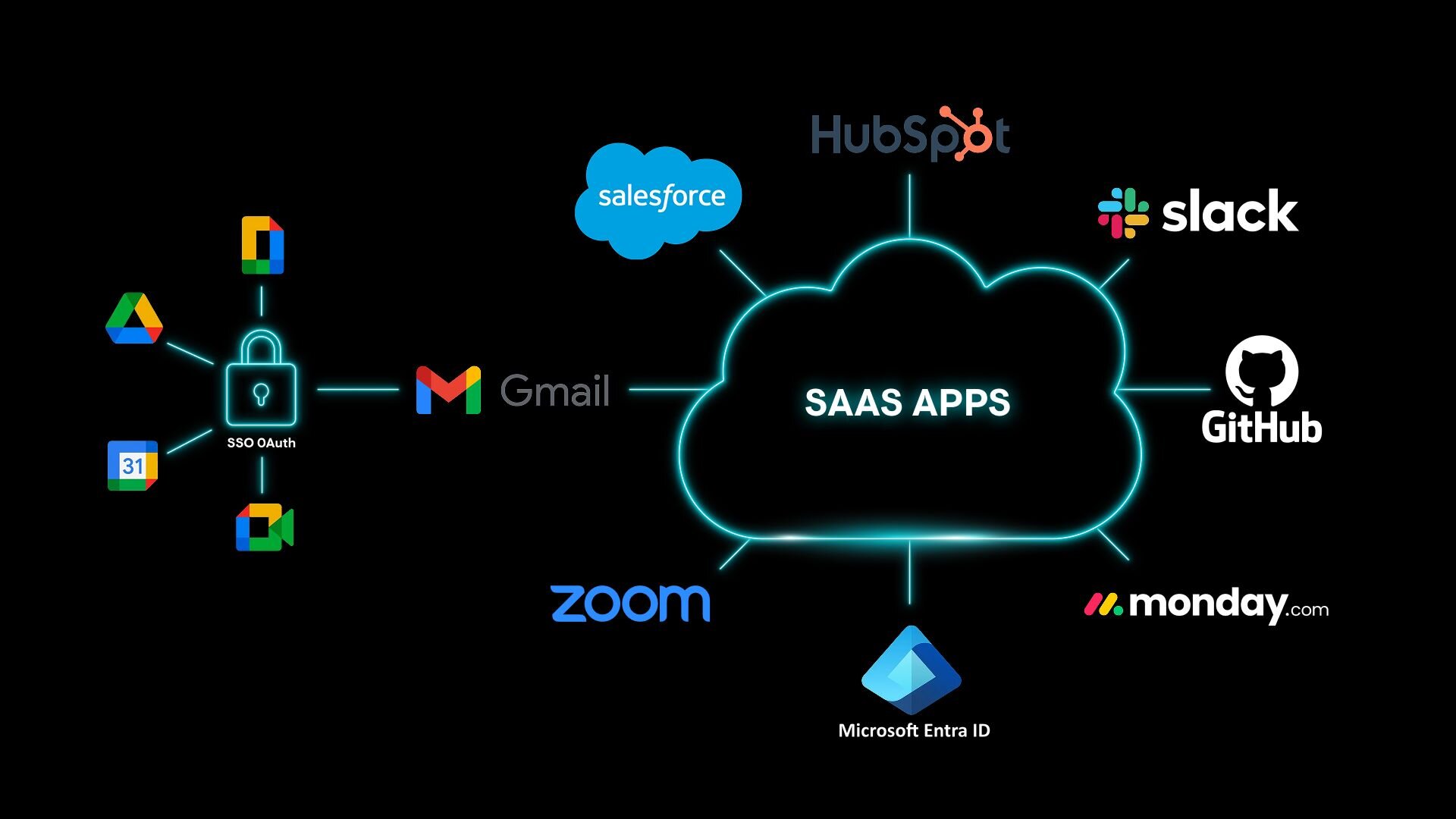
Gmail Identity Sprawl: An Interconnected SaaS World
Glitch effectGlitch effect

SaaS Security Posture Management (SSPM) is a category of security tools that continuously monitors the configuration settings of your cloud-based software applications to catch security gaps, misconfigurations, and policy violations before attackers can exploit them. In plain terms, it keeps a constant watch over the settings inside tools like Microsoft 365, Salesforce, Slack, and Google Workspace — and alerts your team the moment something looks risky or out of compliance.

Key Takeaways

  • SSPM stands for SaaS Security Posture Management — a security discipline focused on protecting cloud-based software applications.

  • Most SaaS apps come with default settings that aren't secure by design, and SSPM helps organizations find and fix those gaps continuously.

  • SSPM gives security teams real-time visibility into misconfigurations, over-permissioned user accounts, third-party app risks, and compliance gaps across their entire SaaS environment.

  • As businesses rely on more SaaS tools than ever before, SSPM has become a critical and often overlooked layer of modern cybersecurity defense.

  • SSPM is especially valuable for small and mid-sized organizations that don't have the staff to manually audit every cloud app they use.

The SaaS explosion — and the security problem that came with it

Over the past decade, businesses of all sizes have moved away from running software on their own servers and toward cloud-based applications software you access through a browser and pay for on a subscription basis. This model is called Software as a Service, or SaaS. Think Microsoft 365 for email, Salesforce for customer data, Slack for team messaging, Zoom for video calls, or DocuSign for contracts.

This shift has been transformative. SaaS tools are easy to set up, accessible from anywhere, and don't require expensive hardware. But they've also created a serious security challenge that many organizations aren't fully prepared for.

Here's the problem: every one of those SaaS applications comes with its own set of configuration settings, user permissions, sharing controls, and integrations. And the average organization is juggling more apps than most people realize. According to BetterCloud's State of SaaSOps report, large enterprises manage upwards of 100+ SaaS applications, and even small businesses often use dozens.

That's dozens of apps. Hundreds of settings. Thousands of users and permissions to track. And when your IT or security team doesn't have full visibility into how each app is configured, mistakes are almost inevitable. A single misconfigured setting, like leaving sensitive documents accessible to anyone with a link, or forgetting to enforce multi-factor authentication, can hand attackers an easy entry point.

SaaS Security Posture Management was created to solve exactly this problem.

What does SSPM actually do?

SSPM tools connect directly to your organization's SaaS applications through their APIs (the technical interfaces that allow software to talk to each other). Once connected, they continuously scan those applications for security misconfigurations, risky permissions, and policy violations, comparing what they find against security best practices and your organization's defined policies.

Here's a closer look at what SSPM typically covers:

  • Monitors Security Configurations: Every SaaS application has an admin settings panel where someone — usually in IT — controls how the tool behaves, who can access it, and what features are turned on or off. SSPM tools monitor those settings 24/7 and benchmark them against established security standards, such as the CIS Benchmarks published by the Center for Internet Security, which provide consensus-based best practices for securing common software platforms. When a setting drifts from those benchmarks, your team gets an alert.

  • Detects Misconfigurations: A misconfiguration is simply a setting that's been configured in a way that creates a security risk, often unintentionally.

  • Examples include: Allowing any user to share files externally without approval, disabling multi-factor authentication (MFA) for admin accounts. Leaving a public-facing shared drive open to anyone who finds the link. Granting full administrative access to users who only need read-only permissions. Enabling legacy authentication protocols that attackers can more easily exploit

These mistakes happen all the time, often because SaaS apps are set up quickly and their default settings aren't secure. SSPM flags these issues before attackers find them.

  • Manages User Permissions and Access: One of the most common — and most dangerous — SaaS security risks is excessive user access. When employees leave the company, their accounts may remain active. When someone changes roles, their old permissions often aren't revoked. Over time, this "permission sprawl" creates a long list of accounts with more access than they should have.

SSPM tools provide clear visibility into who has access to what across all your connected SaaS apps, including:

  • Inactive or orphaned accounts (former employees who still have access)

  • Overprivileged users (people with admin rights who don't need them)

  • External users or guests who may no longer require access

This directly supports the principle of least privilege — the security concept that users should only have access to the specific resources they need to do their job, and nothing more.

Why misconfigurations are such a big deal

It might be tempting to think of misconfigurations as minor, fixable mistakes. But in practice, they're one of the leading causes of cloud security incidents.

CISA's Secure Cloud Business Applications (SCuBA) project — a government initiative specifically designed to help organizations secure their SaaS environments — was launched in part because misconfigured cloud applications continue to be a major risk for federal agencies and private sector organizations alike. The project provides security baselines and configuration guidance for widely used SaaS tools, including Microsoft 365 and Google Workspace.

The tricky thing about misconfigurations is that they're often invisible. Your SaaS apps may appear to be functioning perfectly from a user's perspective — email is going out, files are being shared, deals are being tracked — while underneath, a misconfigured setting is quietly exposing sensitive data or creating an opening for attackers.

Without a dedicated tool to scan for these issues, most organizations simply won't find them until it's too late.

Who needs SSPM?

If your organization uses SaaS applications — and virtually every organization does — SSPM deserves serious consideration. It's particularly important for:

Organizations with large or growing SaaS stacks The more apps you use, the more configurations there are to track, and the greater the chance that something slips through the cracks. SSPM scales with your environment.

Regulated industries Healthcare organizations bound by HIPAA, financial firms navigating SOC 2 requirements, government contractors navigating CMMC,  or businesses operating under GDPR, all face strict rules about how data must be protected. SSPM simplifies compliance monitoring and helps avoid costly violations.

Small and mid-sized businesses (SMBs), Smaller IT and security teams rarely have the bandwidth to manually audit every SaaS tool in their stack. SSPM automates that process, giving lean teams enterprise-grade visibility without requiring additional headcount.

Organizations heavily reliant on Microsoft 365 or Google Workspace. These platforms are among the most widely used and most heavily targeted SaaS environments in the world. SSPM tools typically offer deep integrations with both, making it easier to surface misconfigurations in email, file sharing, identity, and collaboration settings.

Any organization that has experienced rapid SaaS growth. When businesses adopt new apps quickly, especially during periods of remote work or rapid scaling, security configurations often don't get the attention they deserve. SSPM helps bring that sprawl back under control.

Key benefits of SSPM

  • Continuous monitoring: SSPM runs around the clock, not just during scheduled audits. You'll know when something changes the moment it happens.

  • Reduced attack surface: By identifying and remediating misconfigurations proactively, SSPM takes potential entry points away from attackers before they can be exploited.

  • Simplified compliance: Built-in compliance frameworks make it faster and easier to stay audit-ready — without pulling your team away from other priorities.

  • Centralized visibility: Security teams get a single pane of glass showing the security posture of every connected SaaS application, rather than having to log into each tool individually.

  • Faster remediation: Many SSPM tools can automatically fix certain misconfigurations or provide clear, step-by-step guidance to help administrators resolve issues quickly.

  • Third-party risk management: SSPM helps organizations understand exactly which third-party integrations are active, what access they have, and whether any of them pose a risk.

The bottom line

SaaS applications have become the backbone of how modern organizations operate. But that growing reliance on cloud software comes with security risks that traditional tools designed for on-premises environments simply weren't built to address.

SSPM fills that gap. It gives security teams the continuous visibility, automated monitoring, and actionable guidance they need to keep their SaaS environments secure even when those environments are constantly changing and growing.

Whether you're managing ten cloud apps or a hundred, SSPM helps ensure that the settings, permissions, and integrations inside those tools never become the weak link in your cybersecurity defenses.

Glitch effect

Related Resources


What Is ISPM (Identity Security Posture Management)?
What is Identity Security Posture Management (ISPM)? Learn how ISPM acts as a security checkup for user accounts, identifies hidden vulnerabilities like shadow workflows, and secures your digital perimeter.
What Is ESPM (Endpoint Security Posture Management)?
What is ESPM? Learn how Endpoint Security Posture Management continuously audits your devices, closes security gaps, and builds cybersecurity resilience before attackers strike.
What is Cloud Networking?
Learn what cloud networking is, the benefits of secure cloud networking, and the different types of cloud. See what’s best for your business.
What Is Security Posture and Why it Matters
MSP vs. MSSP – Understanding the differences
What is AWS Cloud Security?
What Is a Cloud Compromise Assessment? A Guide for Businesses
What is Security Misconfiguration?
What are Domain Admin Groups?

Protect What Matters

Secure endpoints, email, and employees with the power of our 24/7 SOC. Try Huntress for free and deploy in minutes to start fighting threats.
Try Huntress for Free
Huntress Managed Security PlatformManaged EDRManaged EDR for macOSManaged EDR for LinuxManaged ITDRManaged SIEMManaged Security Awareness TrainingManaged ISPMManaged ESPMBook a Demo
PhishingComplianceBusiness Email CompromiseEducationFinanceHealthcareManufacturingState & Local Government
Managed Service ProvidersResellersIT & Security Teams24/7 SOCCase Studies
BlogResource CenterCybersecurity 101Upcoming EventsSupport Documentation
Our CompanyLeadershipNews & PressCareersContact Us
Huntress white logo

Protecting 215k+ customers like you with enterprise-grade protection.

Privacy PolicyCookie PolicyTerms of UseCookie Consent
Linkedin iconTwitter X iconYouTube iconInstagram icon
© 2025 Huntress All Rights Reserved.

Join the Hunt

Get insider access to Huntress tradecraft, killer events, and the freshest blog updates.

By submitting this form, you accept our Terms of Service & Privacy Policy