





Don’t let overlooked obligations become incidents. Learn how.
Utility navigation bar redirect icon
Portal LoginSupportContact
Search
Close search
Huntress Logo in Teal
  • Platform Overview
    Managed EDR

    Get full endpoint visibility, detection, and response.

    Managed EDR

    Get full endpoint visibility, detection, and response.

    Managed ITDR

    Protect your Microsoft 365 identities and email environments.

    Managed ITDR

    Protect your Microsoft 365 identities and email environments.

    Managed SIEM

    Managed threat response and robust compliance support at a predictable price.

    Managed SIEM

    Managed threat response and robust compliance support at a predictable price.

    Managed Security Awareness Training

    Empower your teams with science-backed security awareness training.

    Managed Security Awareness Training

    Empower your teams with science-backed security awareness training.

    Managed ISPM

    Continuous Microsoft 365 and identity hardening, managed and enforced by Huntress experts.

    Managed ISPM

    Continuous Microsoft 365 and identity hardening, managed and enforced by Huntress experts.

    Managed ESPM

    Proactively secure endpoints against attacks.

    Managed ESPM

    Proactively secure endpoints against attacks.

    Integrations
    Integrations
    Support Documentation
    Support Documentation
    See Huntress in Action

    Quickly deploy and manage real-time protection for endpoints, email, and employees - all from a single dashboard.

    Huntress Cybersecurity
    See Huntress in Action

    Quickly deploy and manage real-time protection for endpoints, email, and employees - all from a single dashboard.

    Huntress Cybersecurity
  • Threats We Stop
    Phishing
    Phishing
    Business Email Compromise
    Business Email Compromise
    Ransomware
    Ransomware
    Infostealers
    Infostealers
    View Allright arrowView Allright arrow
    Industries We Serve
    Education
    Education
    Financial Services
    Financial Services
    State and Local Government
    State and Local Government
    Healthcare
    Healthcare
    Law Firms
    Law Firms
    Manufacturing
    Manufacturing
    Utilities
    Utilities
    View Allright arrowView Allright arrow
    Tailored Solutions
    MSPs
    MSPs
    Resellers
    Resellers
    SMBs
    SMBs
    Compliance
    Compliance
    What Gets Overlooked Gets Exploited

    Most days, nothing happens. But one day, something will.

    Huntress Cybersecurity
    Cybercriminals Have Evolved

    Get the intel on today’s cybercriminal groups and learn how to protect yourself.

    Huntress Cybersecurity
  • Pricing
  • Community Series
    The Product Lab

    Shape the next big thing in cybersecurity together.

    The Product Lab

    Shape the next big thing in cybersecurity together.

    Fireside Chat

    Real people. Real perspectives. Better conversations.

    Fireside Chat

    Real people. Real perspectives. Better conversations.

    Tradecraft Tuesday

    No products, no pitches – just tradecraft.

    Tradecraft Tuesday

    No products, no pitches – just tradecraft.

    _declassified

    Exposing hidden truths in the world of cybersecurity.

    _declassified

    Exposing hidden truths in the world of cybersecurity.

    Resources
    Upcoming Events
    Upcoming Events
    Ebooks
    Ebooks
    On-Demand Webinars
    On-Demand Webinars
    Videos
    Videos
    Whitepapers
    Whitepapers
    Datasheets
    Datasheets
    Cybersecurity Education
    Cybersecurity 101
    Cybersecurity 101
    Cybersecurity Guides
    Cybersecurity Guides
    Threat Library
    Threat Library
    Real Tradecraft, Real Results
    Real Tradecraft, Real Results
    2026 Cyber Threat Report
    2026 Cyber Threat Report
    The Huntress Blog
    Huntress Lands on the Microsoft Marketplace
    Huntress Cybersecurity
    Huntress Lands on the Microsoft Marketplace
    Huntress Cybersecurity
    How Huntress & DEFCERT Are Streamlining CMMC Assessment Prep
    Huntress Cybersecurity
    How Huntress & DEFCERT Are Streamlining CMMC Assessment Prep
    Huntress Cybersecurity
    Live Hacking Into Microsoft 365 with Kyle Hanslovan
    Huntress Cybersecurity
    Live Hacking Into Microsoft 365 with Kyle Hanslovan
    Huntress Cybersecurity
  • Why Huntress

    Go beyond AI in the fight against today’s hackers with Huntress Managed EDR purpose-built for your needs

    Huntress Cybersecurity
    Why Huntress

    Go beyond AI in the fight against today’s hackers with Huntress Managed EDR purpose-built for your needs

    Huntress Cybersecurity
    The Huntress SOC

    24/7 Security Operations Center

    The Huntress SOC

    24/7 Security Operations Center

    Reviews

    Why businesses of all sizes trust Huntress to defend their assets

    Reviews

    Why businesses of all sizes trust Huntress to defend their assets

    Case Studies

    Learn directly from our partners how Huntress has helped them

    Case Studies

    Learn directly from our partners how Huntress has helped them

    Community

    Get in touch with the Huntress Community team

    Community

    Get in touch with the Huntress Community team

    Compare Huntress
    Bitdefender
    Bitdefender
    Blackpoint
    Blackpoint
    Breach Secure Now!
    Breach Secure Now!
    Crowdstrike
    Crowdstrike
    Datto
    Datto
    SentinelOne
    SentinelOne
    Sophos
    Sophos
    Compare Allright arrowCompare Allright arrow
  • HUNTRESS HUB

    Login to access top-notch marketing resources, tools, and training.

    Huntress Cybersecurity
    HUNTRESS HUB

    Login to access top-notch marketing resources, tools, and training.

    Huntress Cybersecurity
    Partners
    MSPs

    Join our partner community to deliver expert-led managed security.

    MSPs

    Join our partner community to deliver expert-led managed security.

    Resellers

    Partner program designed to grow your cybersecurity business.

    Resellers

    Partner program designed to grow your cybersecurity business.

    Tech Alliances

    Driving innovation through global technology Partnerships

    Tech Alliances

    Driving innovation through global technology Partnerships

    Microsoft Partnership

    A Level-Up for Your Business Security

    Microsoft Partnership

    A Level-Up for Your Business Security

  • Press Release
    Huntress Announces Collaboration with Microsoft to Strengthen Cybersecurity for Businesses of All Sizes
    Huntress Cybersecurity
    Press Release
    Huntress Announces Collaboration with Microsoft to Strengthen Cybersecurity for Businesses of All Sizes
    Huntress Cybersecurity
    Our Story

    We're on a mission to shatter the barriers to enterprise-level security.

    Our Story

    We're on a mission to shatter the barriers to enterprise-level security.

    Newsroom

    Explore press releases, news articles, media interviews and more.

    Newsroom

    Explore press releases, news articles, media interviews and more.

    Meet the Team

    Founded by former NSA Cyber Operators. Backed by security researchers.

    Meet the Team

    Founded by former NSA Cyber Operators. Backed by security researchers.

    Careers

    Ready to shake up the cybersecurity world? Join the hunt.

    Careers

    Ready to shake up the cybersecurity world? Join the hunt.

    Awards
    Awards
    Contact Us
    Contact Us
  • Portal Login
  • Support
  • Contact
  • Search
  • Get a Demo
  • Start for Free
Portal LoginSupportContact
Search
Close search
Get a Demo
Start for Free
HomeBlog
What Is Cyber Threat Hunting? Types, Tricks, and Tips
Last Updated:
December 1, 2025

What Is Cyber Threat Hunting? Types, Tricks, and Tips

By:
Anthony Smith
Contributors:
Special thanks to our Contributors:
Lizzie Danielson
Share icon
Glitch effectGlitch effectGlitch effect

In a world where cyber threats evolve at a blazing-fast pace, relying solely on reactive measures isn’t enough.

Enter: threat hunting, a proactive approach that uses threat intelligence, alerts, and log data—or even technical experience—to create and define hypotheses that can be tested to find unknown threats, security gaps, and potential zerodays.

As cyber threats become more sophisticated, threat hunting empowers businesses to seek out and neutralize threats before they can cause significant damage. Our cybercrime report revealed that 58% of businesses lost at least $100,000 from cybercrime in 2025, proving that proactive measures are more important than ever. 

Keep reading to learn more about what threat hunting is, how it works, and why it matters.


What is cyber threat hunting?

Threat hunting is the proactive search across networks and endpoints to identify signs of malicious activity often missed by traditional security defenses. Unlike conventional security measures, which rely on alerts triggered by known threats or vulnerabilities, threat hunting happens before the threat goes down. 

It involves asking critical questions and testing hypotheses about potential threats based on observed behaviors or patterns. Think of it as spotting the smoke before the fire—catching early indicators of compromise before they turn into full-blown incidents.


Threat hunting vs. threat detection vs. threat intelligence

These three practices—threat hunting, threat detection, and threat intelligence—are different, but each has an essential role in modern cybersecurity strategies. At a high level, threat hunting is proactive, threat detection is reactive, and threat intelligence provides the context and data that make both more effective.

Here’s an overview of their differences and similarities:


Threat hunting

Threat detection

Threat intelligence

Main goal

Find hidden, unknown threats that have bypassed automated defenses

Identify known malicious activity and generate alerts

Provide context and knowledge about external and emerging threats to inform defenses

Approach

Proactive, human-driven

Reactive, automated

Analytical, research-based

Input/triggers

Alerts from security tools (SIEM, EDR, IDS/IPS)

Hypothesis, threat intelligence reports, or hunches based on internal context

Raw data, OSINT, dark web, security vendor feeds, internal hunting findings

Output

New detection rules and new threat intelligence

Security alerts, incident creation

Actionable reports and feeds 

Timing

Periodic or continuous

Real-time or near real-time

Continuous collection and analysis

Key tools

SIEM querying, EDR, network analysis tools, custom scripts

SIEM, EDR, IDS/IPS, antivirus

Threat intelligence platforms (TIPs), OSINT tools, feeds, and databases


How threat hunting works

The threat hunting process is proactive, so it can start at any time. Here’s a brief look at how it works, in most cases:

  1. Trigger: The hunt starts by identifying a trigger—this may come from alerts generated by security tools like SIEM (Security Information and Event Management) systems, or from abnormal network behaviors.

  2. Investigation: The next phase involves deep investigations to analyze the gathered data, using analytics and potentially machine learning tools for pattern recognition and anomaly detection.

  3. Resolution: Finally, once the hunter finds proof, it's time to act—patch vulnerabilities, update security policies, and remove malicious artifacts so the threat doesn't come back.
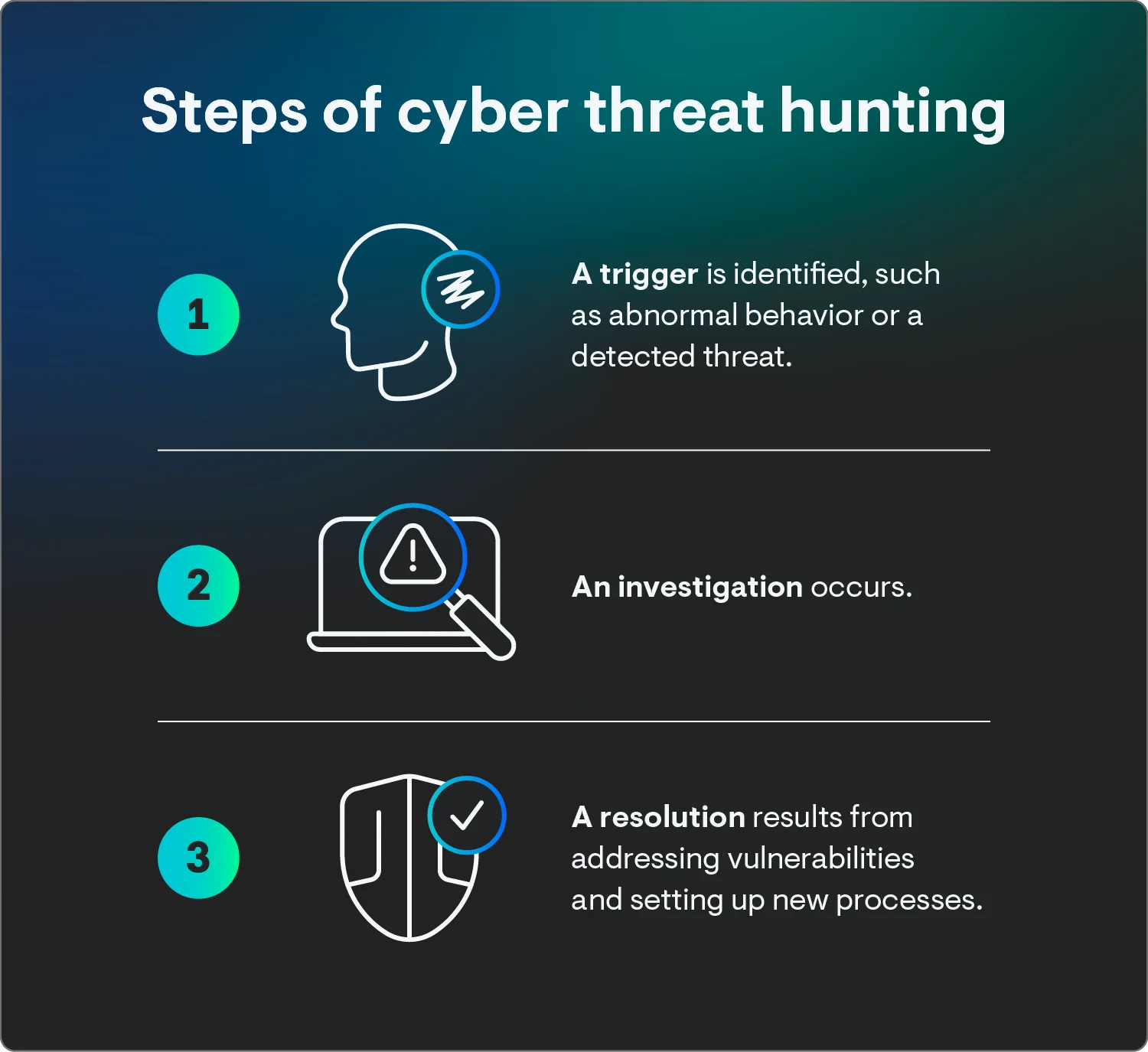
The steps of cyber threat hunting, including trigger, investigation, and resolution


Types of threat hunting

All types of cyber threat hunting fall into two main categories: structured or unstructured. 

  • Structured threat hunting is the more common and potentially more efficient approach as a specific goal of figuring out these threats. The hunter has an idea of the tactic, technique, or procedure (TTP) they’re looking for.

  • Unstructured threat hunting is data science applied to security. It’s driven by hypothesis, but it's necessary because advanced attackers often employ never-before-seen techniques that bypass existing rules and known TTPs.


Threat hunting methodologies

Everyone has their own approach or way of thinking about things, and that goes for researchers, too. While there are two main types of hunts, there are also four hunting methodologies:intelligence-driven, data-driven, knowledge-driven, and hybrid hunts. 

1. Intelligence-driven hunts 

Intelligence hunting is a structured hunt that involves collecting and analyzing intelligence from various sources to execute the hunt mission. Intel can consist of file names, hashes, IPs, campaigns, IOCs, email addresses, domains, etc. Using the collected intelligence, we can create hypotheses to test against internal data sources.

2. Data-driven hunts

These unstructured hunts rely on internal data that could potentially indicate malicious behavior. The types of data often include low-priority alerts, detections,or aggregated analytics.

This data does not give us our “smoking gun,” nor does it mean anything bad is happening at all, but it gives us a good starting point to create hypotheses on what we’re seeing.

3. Knowledge-driven hunts

Knowledge-driven hunts rely on our knowledge of available data sets, client networks, and adversary TTPs. Knowing adversary TTPs lets us identify and recognize potential threat behaviors. Using frameworks like MITRE ATT&CK, we can create hypotheses based on threat actor TTPs that have been seen in the wild.

4. Hybrid hunts

Hybrid hunts combine two or more types of hunts, which can help us create hypotheses with a narrower scope. For example, if data shows certain events happening on endpoints and intel suggests that these events could be part of a campaign that adversaries are conducting, we can create a hypothesis that combines both data-driven and intelligence-driven approaches.


Threat hunting best practices

When threat hunting, there are some good ways to do things and some… less good ways to do things. Here's how to make sure you’re doing things the good, good way:

  • Know your environment: Understanding what "normal" looks like in your network helps identify anomalies that signal threats.

  • Use threat intelligence: Incorporate intel feeds to stay informed about current threat landscapes.

  • Engage continuous learning: Threat landscapes evolve—regular training and knowledge updates for your threat hunting team are essential.

  • Foster an adversarial mindset: Encourage hunters to be curious, skeptical, and to actively "think like the attacker." Adopt an “assume breach” mindset.

  • Develop diverse skills: A successful hunter needs a mix of skills: data analysis, network forensics, malware analysis, and often scripting/coding (Python, PowerShell) to automate repetitive tasks and create custom tools.

  • Dedicated time and resources: Threat hunting should be a defined, scheduled activity, not something analysts do if they have free time. The most mature programs have dedicated hunt teams.

  • Automate successful hunts: If a hunting query successfully finds a threat, the goal is to "Hunt Once, Detect Forever." The successful query should be immediately translated into a new, automated detection rule in the SIEM or EDR (Endpoint Detection and Response), freeing the hunter to focus on the next unknown threat.


Threat detection tools

Every hunter needs a good set of tools for a successful hunt. Here are some commonly used threat detection tools:

  • Security Information and Event Management (SIEM): HuntressManaged SIEM brings enterprise-grade SIEM capabilities to any threat hunting team, centralizing logs and alerts from across your environment so that potential incidents can't hide in the noise.

  • Endpoint detection and response (EDR): Get the upper hand against threat actors with either managed or unmanaged endpoint protection that focuses on tracking and analyzing activities on endpoints to detect malicious behavior.

  • Threat intelligence platforms (TIPs): Aggregate threat data from multiple sources—valuable for both proactive and reactive measures.


Why threat hunting matters

At the end of the day, software can't out-think a human. Machine learning and automation have their place, but they still require humans to make the last-minute decision to contain and respond accurately.

And modern threat actors are smart and know how to exploit those blind spots. They’ve got entire teams that spend their days identifying ways to abuse, exploit, or slip past IT security tools. How can you expect to beat that with automation alone?

That's why we need hunters on the front lines. A threat hunter with a well-trained eye is more likely to pick up on TTPs and suspicious activity and can actually help software-based tools be more accurate. Overall, threat hunting enables security teams to identify unknown threats and catch them before they cause major damage and disruption.


Leave the threat hunting to Huntress

As we’ve seen threat actors working nonstop, we’ve also seen threat hunting become an essential part of modern defense. If you think about it, attackers have the first-move advantage in most scenarios—their victims aren’t even aware of their presence until it’s too late.

Threat hunting helps close that gap. Human-powered threat hunting is all about being proactive, combining technical and behavioral analysis to help businesses stay ahead of the latest threats and catch them before they can do more damage.

Huntress Managed SIEM uses proprietary Smart Filtering technology that only captures the data you need and cuts through all the noise. Our 24/7 expert-led monitoring helps you find and wreck elusive hackers.

Learn more about Huntress Managed SIEM, and happy hunting!


FAQ

What is the main objective of threat hunting? 

The main objective of threat hunting is to proactively search for and identify hidden, unknown malicious activity that slips past existing automated security controls and detection systems. 

What is the difference between SOC and threat hunting?

The security operations center (SOC) is the central, general-purpose team responsible for monitoring, detecting, analyzing, and responding to known security incidents reactively. Threat hunting is the human-driven, proactive discipline within the SOC focused on searching for unknown and persistent threats that have evaded the standard automated SOC tools.

What are four main types of threats? 

Cyber threats are usually divided into four main types: malware, social engineering, network attacks, and application or web attacks.





Categories
Cybersecurity Education
Summarize this postClose Speech Bubble
ChatGPTClaudePerplexityGoogle AI

See Huntress is Action

See how our platform combines powerful managed detection and response tools, science-backed security training, and 24/7 SOC expertise to keep your business secure.
Book a Demo
Share
Facebook iconTwitter X iconLinkedin iconDownload icon
Glitch effect

You Might Also Like

  • Breaking Down the Threat Hunting Process

    Discover the key phases of the threat hunting process and how threat hunters structure their hunts to proactively seek out threats.
  • Threat Hunting and Tactical Malware Analysis

    Dive into the basics of threat hunting and tactical malware analysis, and learn how these two practices go hand in hand in cybersecurity.
  • What Is Human-Powered Threat Hunting?

    In this blog, we define what threat hunting is, the differences between human analysis and automation, plus an example of human-powered threat hunting.
  • Threat Hunting for Business Email Compromise Through User Agents

    Can we use anomalous user agents to detect potential business email compromise (BEC) in Microsoft 365? Explore what we found through threat hunting for BEC.
  • Hunting for M365 Password Spraying

    Join Huntress Threat Hunters as they unpack the password-spraying techniques of threat actors, exposing how they target everything from small businesses to giants like Microsoft.
  • Should We Be Playing Offense or Defense in Cybersecurity?

    In this blog, we debate which is the best approach for IT professionals to beat hackers: offensive cybersecurity or defensive cybersecurity.
  • What's the Value of Telemetry-driven Investigations & Managed EDR?

    Learn more about what it actually means to go up against hackers–and why creative, human-led investigations are essential for keeping your organization safe from modern threats.
  • What Is Endpoint Detection and Response?

    What is endpoint detection and response (EDR) and why is it important? Dive into what EDR is, its history and what to look for in EDR solutions today.

Sign Up for Huntress Updates

Get insider access to Huntress tradecraft, killer events, and the freshest blog updates.
Privacy • Terms
By submitting this form, you accept our Terms of Service & Privacy Policy
Thank you! Your submission has been received!
Oops! Something went wrong while submitting the form.
Huntress Managed Security PlatformManaged EDRManaged EDR for macOSManaged EDR for LinuxManaged ITDRManaged SIEMManaged Security Awareness TrainingManaged ISPMManaged ESPMBook a Demo
PhishingComplianceBusiness Email CompromiseEducationFinanceHealthcareManufacturingState & Local Government
Managed Service ProvidersResellersIT & Security Teams24/7 SOCCase Studies
BlogResource CenterCybersecurity 101Upcoming EventsSupport Documentation
Our CompanyLeadershipNews & PressCareersContact Us
Huntress white logo

Protecting 215k+ customers like you with enterprise-grade protection.

Privacy PolicyCookie PolicyTerms of UseCookie Consent
Linkedin iconTwitter X iconYouTube iconInstagram icon
© 2025 Huntress All Rights Reserved.

Join the Hunt

Get insider access to Huntress tradecraft, killer events, and the freshest blog updates.

By submitting this form, you accept our Terms of Service & Privacy Policy