





Don’t let overlooked obligations become incidents. Learn how.
Utility navigation bar redirect icon
Portal LoginSupportContact
Search
Close search
Huntress Logo in Teal
  • Platform Overview
    Managed EDR

    Get full endpoint visibility, detection, and response.

    Managed EDR

    Get full endpoint visibility, detection, and response.

    Managed ITDR

    Protect your Microsoft 365 identities and email environments.

    Managed ITDR

    Protect your Microsoft 365 identities and email environments.

    Managed SIEM

    Managed threat response and robust compliance support at a predictable price.

    Managed SIEM

    Managed threat response and robust compliance support at a predictable price.

    Managed Security Awareness Training

    Empower your teams with science-backed security awareness training.

    Managed Security Awareness Training

    Empower your teams with science-backed security awareness training.

    Managed ISPM

    Continuous Microsoft 365 and identity hardening, managed and enforced by Huntress experts.

    Managed ISPM

    Continuous Microsoft 365 and identity hardening, managed and enforced by Huntress experts.

    Managed ESPM

    Proactively secure endpoints against attacks.

    Managed ESPM

    Proactively secure endpoints against attacks.

    Integrations
    Integrations
    Support Documentation
    Support Documentation
    See Huntress in Action

    Quickly deploy and manage real-time protection for endpoints, email, and employees - all from a single dashboard.

    Huntress Cybersecurity
    See Huntress in Action

    Quickly deploy and manage real-time protection for endpoints, email, and employees - all from a single dashboard.

    Huntress Cybersecurity
  • Threats We Stop
    Phishing
    Phishing
    Business Email Compromise
    Business Email Compromise
    Ransomware
    Ransomware
    Infostealers
    Infostealers
    View Allright arrowView Allright arrow
    Industries We Serve
    Education
    Education
    Financial Services
    Financial Services
    State and Local Government
    State and Local Government
    Healthcare
    Healthcare
    Law Firms
    Law Firms
    Manufacturing
    Manufacturing
    Utilities
    Utilities
    View Allright arrowView Allright arrow
    Tailored Solutions
    MSPs
    MSPs
    Resellers
    Resellers
    SMBs
    SMBs
    Compliance
    Compliance
    What Gets Overlooked Gets Exploited

    Most days, nothing happens. But one day, something will.

    Huntress Cybersecurity
    Cybercriminals Have Evolved

    Get the intel on today’s cybercriminal groups and learn how to protect yourself.

    Huntress Cybersecurity
  • Pricing
  • Community Series
    The Product Lab

    Shape the next big thing in cybersecurity together.

    The Product Lab

    Shape the next big thing in cybersecurity together.

    Fireside Chat

    Real people. Real perspectives. Better conversations.

    Fireside Chat

    Real people. Real perspectives. Better conversations.

    Tradecraft Tuesday

    No products, no pitches – just tradecraft.

    Tradecraft Tuesday

    No products, no pitches – just tradecraft.

    _declassified

    Exposing hidden truths in the world of cybersecurity.

    _declassified

    Exposing hidden truths in the world of cybersecurity.

    Resources
    Upcoming Events
    Upcoming Events
    Ebooks
    Ebooks
    On-Demand Webinars
    On-Demand Webinars
    Videos
    Videos
    Whitepapers
    Whitepapers
    Datasheets
    Datasheets
    Cybersecurity Education
    Cybersecurity 101
    Cybersecurity 101
    Cybersecurity Guides
    Cybersecurity Guides
    Threat Library
    Threat Library
    Real Tradecraft, Real Results
    Real Tradecraft, Real Results
    2026 Cyber Threat Report
    2026 Cyber Threat Report
    The Huntress Blog
    Huntress Lands on the Microsoft Marketplace
    Huntress Cybersecurity
    Huntress Lands on the Microsoft Marketplace
    Huntress Cybersecurity
    How Huntress & DEFCERT Are Streamlining CMMC Assessment Prep
    Huntress Cybersecurity
    How Huntress & DEFCERT Are Streamlining CMMC Assessment Prep
    Huntress Cybersecurity
    Live Hacking Into Microsoft 365 with Kyle Hanslovan
    Huntress Cybersecurity
    Live Hacking Into Microsoft 365 with Kyle Hanslovan
    Huntress Cybersecurity
  • Why Huntress

    Go beyond AI in the fight against today’s hackers with Huntress Managed EDR purpose-built for your needs

    Huntress Cybersecurity
    Why Huntress

    Go beyond AI in the fight against today’s hackers with Huntress Managed EDR purpose-built for your needs

    Huntress Cybersecurity
    The Huntress SOC

    24/7 Security Operations Center

    The Huntress SOC

    24/7 Security Operations Center

    Reviews

    Why businesses of all sizes trust Huntress to defend their assets

    Reviews

    Why businesses of all sizes trust Huntress to defend their assets

    Case Studies

    Learn directly from our partners how Huntress has helped them

    Case Studies

    Learn directly from our partners how Huntress has helped them

    Community

    Get in touch with the Huntress Community team

    Community

    Get in touch with the Huntress Community team

    Compare Huntress
    Bitdefender
    Bitdefender
    Blackpoint
    Blackpoint
    Breach Secure Now!
    Breach Secure Now!
    Crowdstrike
    Crowdstrike
    Datto
    Datto
    SentinelOne
    SentinelOne
    Sophos
    Sophos
    Compare Allright arrowCompare Allright arrow
  • HUNTRESS HUB

    Login to access top-notch marketing resources, tools, and training.

    Huntress Cybersecurity
    HUNTRESS HUB

    Login to access top-notch marketing resources, tools, and training.

    Huntress Cybersecurity
    Partners
    MSPs

    Join our partner community to deliver expert-led managed security.

    MSPs

    Join our partner community to deliver expert-led managed security.

    Resellers

    Partner program designed to grow your cybersecurity business.

    Resellers

    Partner program designed to grow your cybersecurity business.

    Tech Alliances

    Driving innovation through global technology Partnerships

    Tech Alliances

    Driving innovation through global technology Partnerships

    Microsoft Partnership

    A Level-Up for Your Business Security

    Microsoft Partnership

    A Level-Up for Your Business Security

  • Press Release
    Huntress Announces Collaboration with Microsoft to Strengthen Cybersecurity for Businesses of All Sizes
    Huntress Cybersecurity
    Press Release
    Huntress Announces Collaboration with Microsoft to Strengthen Cybersecurity for Businesses of All Sizes
    Huntress Cybersecurity
    Our Story

    We're on a mission to shatter the barriers to enterprise-level security.

    Our Story

    We're on a mission to shatter the barriers to enterprise-level security.

    Newsroom

    Explore press releases, news articles, media interviews and more.

    Newsroom

    Explore press releases, news articles, media interviews and more.

    Meet the Team

    Founded by former NSA Cyber Operators. Backed by security researchers.

    Meet the Team

    Founded by former NSA Cyber Operators. Backed by security researchers.

    Careers

    Ready to shake up the cybersecurity world? Join the hunt.

    Careers

    Ready to shake up the cybersecurity world? Join the hunt.

    Awards
    Awards
    Contact Us
    Contact Us
  • Portal Login
  • Support
  • Contact
  • Search
  • Get a Demo
  • Start for Free
Portal LoginSupportContact
Search
Close search
Get a Demo
Start for Free
HomeBlog
What Is Human-Powered Threat Hunting?
Published:
March 2, 2021

What Is Human-Powered Threat Hunting?

By:
John Hammond
Share icon
Glitch effectGlitch effectGlitch effect

Hunting is a tale as old as time. Humans have been hunting for thousands of years—whether it be against prey or foe. While the hunt looks a bit different in the realm of cybersecurity, there’s one thing that still applies—nothing beats human instinct. 

Now you may be thinking, “what about human error? Isn’t that what attackers exploit?” Yes, but that’s not what this blog post is about.

We’re talking about cyber threat hunting. Many security tools rely on automation to do some sort of threat detection but many are missing that human element. In this blog, we’ll dive into what threat hunting is, the differences between human analysis and automation and an example of human-powered threat hunting in action.

What is Threat Hunting?

Threat hunting is the practice of searching for cyber threats that are lurking in the shadows. It’s grown to become an essential component of any cybersecurity strategy. Threat hunting focuses on finding indicators to help you hunt, then you need to validate your indicators are working, rinse and repeat.

But much of the challenge is that you need a certain level of confidence to confirm you’ve identified something that is actually malicious (or at least something you want to investigate). Otherwise, you get false positives and potential service disruption.

Basic Threat Hunting- Blog Thumbnail

So what’s the answer? Adding humans into the mix. 

Cyber defenders will always look for opportunities to automate—it’s critical to keep up with the pace and scale at which attacks are growing, both in sophistication and in sheer volume. At the same time, there must be a human element to assist in recognizing and hunting down threats.


Threat Hunting with Humans vs. Automation

When it comes to identifying malicious activity, context is key. If automation could handle this on its own, then we wouldn’t even need this blog post. But for argument’s sake, let’s take a look at the pros and cons of automation vs. human analysis:

Blog Image_ Humans vs. Automation

In my opinion, the real value of human threat analysis stems from two things: context and experience. 

If a human recognizes, "hey, a cmd.exe program is running as a child process to my Microsoft Word program" they have the know-how that this is very suspicious and shouldn't be happening. Obviously, that is a simple example—automated solutions could detect that strange behavior, but only because a human programmed that software to know that is bad. What about the things that automation hasn't "learned" about? 

Some forms of obfuscation or evasion techniques can still slip past an automated solution—and it demands a real human being to work through it and understand it—because the automated program will just ignore it and move on to the next thing.

Now, it doesn’t have to be one column or the other. Automation is certainly key, but it has its limitations. As does human analysis. 

The key could be combining automation with human intelligence, and I think my fellow ThreatOps teammate said it best on the matter:

“When it comes to threat hunting, humans and automation should complement each other. We simply cannot rely on one over the other because they each have a part to play. Automation is great for certain aspects, such as catching and flagging known malware patterns. But a human analyst can decipher what is truly malicious or spot a command that was designed to evade antivirus. In my opinion, threat hunting is strongest when you have automation and human analysis working together.” - Cat Contillo, Huntress ThreatOps Analyst


What is ThreatOps?

ThreatOps is the synthesis of using not only automated security detection algorithms, but also manual and human analysis from security practitioners’ reverse engineering and understanding malware. The real strength comes from the human analysis, while both techniques supplement each other and make for better detections than just one strategy alone.

At Huntress, our Security Operations Center (SOC) team gives us the ability to look at the context and environmental factors to decide if something is malicious or not, or even catch something that slipped past other preventive tools. This tight feedback loop allows us to operate at the speed of attackers. As soon as a new malware variant emerges, an analyst can appropriately classify it and retroactively apply it to all systems.

Huntress SOC in Action

Our blog is full of examples that showcase the power of human threat hunting—but there are hundreds more that we just haven’t been able to write about yet. 

To give you a taste, we’ve come across things like fake antivirus programs where malware masqueraded as a "kaspersky.exe," and even layers and layers of nested obfuscation that some automated scanners couldn’t work their way through. We’ve dealt with fileless malware, or that one time a VBScript called JScript which then called PowerShell to download and reflectively load in C# assemblies—the whole gamut. 

If you really want to see our SOC team in action, let’s dive into this example of Emotet, a well-known trojan that continues to evade security products—which CISA warned us of last year.

Emotet vs. The Huntress SOC 

For background, Emotet is a common malware delivery mechanism nowadays, often dropping multiple malware strains onto a compromised host. Sometimes, it’s other well-known strains such as Trickbot or Dridex, other times it’s highly destructive ransomware like Ryuk. The good news is that Emotet isn’t invisible; it does leave traces that can be detected if you know what to look for.

As described in this alert, “Emotet artifacts are typically found in arbitrary paths located off of the AppData\Local and AppData\Roaming directories. The artifacts usually mimic the names of known executables. Persistence is typically maintained through Scheduled Tasks or via registry keys. Additionally, Emotet creates randomly named files in the system root directories that are run as Windows services. When executed, these services attempt to propagate the malware to adjacent systems via accessible administrative shares.”

Emotet-service-entry

Emotet service entry

Emotet can often appear as a service, usually as two words chained together. The other giveaway is that the Emotet service copies a service description from another legitimate service on the host. 

Examining the “Service Manager” snap-in for duplicate service descriptions can reveal these malicious services. When executed, these services attempt to propagate the malware and move laterally through the network via administrative shares.

Emotet Persistence

In addition to services, Emotet has been known to use Scheduled Tasks and Registry Run keys. Perhaps a good task for automation—but how can an automation engine know when it’s looking at a malicious persistence mechanism?

It is not uncommon for new Scheduled Tasks and registry values to be created as part of normal system operation. Lists of “known bad” help tremendously to weed out a majority of Emotet infections, but known lists will only take you so far. Most importantly, automation engines require the right pattern match or signature in order to know when it has encountered a malicious file. If the malicious file changes ever so slightly, it may take several cycles before these engines realize the relationship to previously seen malware before updating the signature.

Huntress SOC analysts have seen this same naming scheme several times over despite having no antivirus alerts for this file. Human intuition and previous experience tell us something suspicious is occurring.
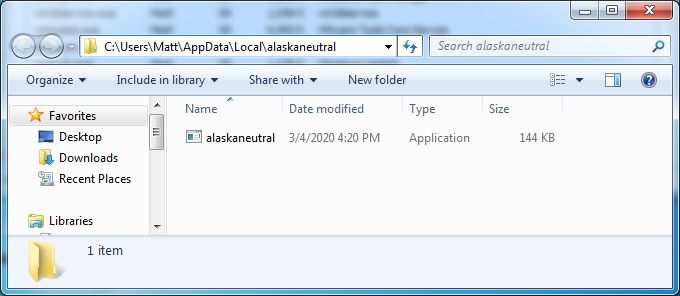
Emotet artifact in AppData/Local

Path to executable: “C:\Users\Matt\AppData\Local\alaskaneutral\alaskaneutral.exe”

This artifact is in AppData\Local just like what is listed in the US-CERT alert, reinforcing this is likely Emotet.

Inspecting the security tab and certificate section of the file will reveal interesting attributes. Even with glaring file abnormalities like these, Emotet slips past automated systems.
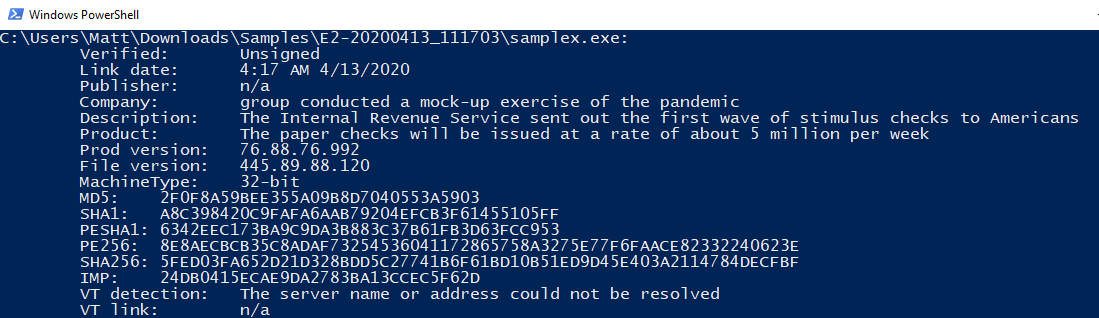
Emotet binary

Signature information from an Emotet binary

Some security products might overlook a file like this based on how it decides if a file is malicious. For some engines, unknown files will be assigned a score based on various indicators and attributes. If the score doesn’t meet a predefined threshold, then the file will not be marked as malicious enough to take action—something many sophisticated attackers are acutely aware of.

On the other hand, human threat analysts have a trained eye for these types of traces and telltale signs. We’re able to make decisions and educated judgments based on what we’re looking at, without being constrained by a specific set of rules like automation is. 

At the end of the day, human attackers are constantly improving their evasion techniques—and as human defenders, we must continually improve our detection capabilities to keep pace with the latest threats.

Special thanks to Cat Contillo and Annie Ballew for their help with this post.

Categories
Cybersecurity Education
Summarize this postClose Speech Bubble
ChatGPTClaudePerplexityGoogle AI

See Huntress in action.

Our platform combines a suite of powerful managed detection and response tools for endpoints and Microsoft 365 identities, science-backed security awareness training, and the expertise of our 24/7 Security Operations Center (SOC).
Book a Demo
Share
Facebook iconTwitter X iconLinkedin iconDownload icon
Glitch effect

You Might Also Like

  • What Is Cyber Threat Hunting? Types, Tricks, and Tips

    What is cyber threat hunting, and what do threat hunters do? In this blog, we define what threat hunting actually is and the strategy and skill behind it.
  • Advanced Persistent Threat Targeting Vietnamese Human Rights Defenders

    Huntress identified an intrusion against a non-profit supporting Vietnamese human rights that’s likely spanned years. Jump in as we provide a thorough analysis of this malicious threat actor.
  • Humans vs. AI: The Critical Role of Human Expertise in Cybersecurity

    Can AI ever fully replace humans in cybersecurity? We argue that human-powered security is the key to staying one step ahead of today’s threats.
  • What Is a Persistent Foothold?

    We hunt for persistent footholds, but what exactly does that mean? In this blog, we define what a foothold is and why it's a hacker favorite.
  • Dollars and Sense: The True Value of the Huntress SOC Team

    Automation is great—but when it comes to threat detection and analysis, it doesn’t replace the need for human expertise.
  • Scale Your Security Operations with Confidence

    Are you ready to scale your MSP or SMB? Level up your threat detection and response so you can focus on what's important: your business.
  • Endpoint Protection: Promises vs. Reality

    An in-depth look at the differences between AV, NGAV and EDR. We’ll explore the promises endpoint protection tools make vs. their ability to keep them.
  • Threat Hunting and Tactical Malware Analysis

    Dive into the basics of threat hunting and tactical malware analysis, and learn how these two practices go hand in hand in cybersecurity.

Sign Up for Huntress Updates

Get insider access to Huntress tradecraft, killer events, and the freshest blog updates.
Privacy • Terms
By submitting this form, you accept our Terms of Service & Privacy Policy
Thank you! Your submission has been received!
Oops! Something went wrong while submitting the form.
Huntress Managed Security PlatformManaged EDRManaged EDR for macOSManaged EDR for LinuxManaged ITDRManaged SIEMManaged Security Awareness TrainingManaged ISPMManaged ESPMBook a Demo
PhishingComplianceBusiness Email CompromiseEducationFinanceHealthcareManufacturingState & Local Government
Managed Service ProvidersResellersIT & Security Teams24/7 SOCCase Studies
BlogResource CenterCybersecurity 101Upcoming EventsSupport Documentation
Our CompanyLeadershipNews & PressCareersContact Us
Huntress white logo

Protecting 215k+ customers like you with enterprise-grade protection.

Privacy PolicyCookie PolicyTerms of UseCookie Consent
Linkedin iconTwitter X iconYouTube iconInstagram icon
© 2025 Huntress All Rights Reserved.

Join the Hunt

Get insider access to Huntress tradecraft, killer events, and the freshest blog updates.

By submitting this form, you accept our Terms of Service & Privacy Policy