




Don’t let overlooked obligations become incidents. Learn how.
Utility navigation bar redirect icon
Portal LoginSupportContact
Search
Close search
Huntress Logo in Teal
  • Platform Overview
    Managed EDR

    Get full endpoint visibility, detection, and response.

    Managed EDR

    Get full endpoint visibility, detection, and response.

    Managed ITDR

    Protect your Microsoft 365 identities and email environments.

    Managed ITDR

    Protect your Microsoft 365 identities and email environments.

    Managed SIEM

    Managed threat response and robust compliance support at a predictable price.

    Managed SIEM

    Managed threat response and robust compliance support at a predictable price.

    Managed Security Awareness Training

    Empower your teams with science-backed security awareness training.

    Managed Security Awareness Training

    Empower your teams with science-backed security awareness training.

    Managed ISPM

    Continuous Microsoft 365 and identity hardening, managed and enforced by Huntress experts.

    Managed ISPM

    Continuous Microsoft 365 and identity hardening, managed and enforced by Huntress experts.

    Managed ESPM

    Proactively secure endpoints against attacks.

    Managed ESPM

    Proactively secure endpoints against attacks.

    Integrations
    Integrations
    Support Documentation
    Support Documentation
    See Huntress in Action

    Quickly deploy and manage real-time protection for endpoints, email, and employees - all from a single dashboard.

    Huntress Cybersecurity
    See Huntress in Action

    Quickly deploy and manage real-time protection for endpoints, email, and employees - all from a single dashboard.

    Huntress Cybersecurity
  • Threats We Stop
    Phishing
    Phishing
    Business Email Compromise
    Business Email Compromise
    Ransomware
    Ransomware
    Infostealers
    Infostealers
    View Allright arrowView Allright arrow
    Industries We Serve
    Education
    Education
    Financial Services
    Financial Services
    State and Local Government
    State and Local Government
    Healthcare
    Healthcare
    Law Firms
    Law Firms
    Manufacturing
    Manufacturing
    Utilities
    Utilities
    View Allright arrowView Allright arrow
    Tailored Solutions
    MSPs
    MSPs
    Resellers
    Resellers
    SMBs
    SMBs
    Compliance
    Compliance
    What Gets Overlooked Gets Exploited

    Most days, nothing happens. But one day, something will.

    Huntress Cybersecurity
    Cybercriminals Have Evolved

    Get the intel on today’s cybercriminal groups and learn how to protect yourself.

    Huntress Cybersecurity
  • Pricing
  • Community Series
    The Product Lab

    Shape the next big thing in cybersecurity together.

    The Product Lab

    Shape the next big thing in cybersecurity together.

    Fireside Chat

    Real people. Real perspectives. Better conversations.

    Fireside Chat

    Real people. Real perspectives. Better conversations.

    Tradecraft Tuesday

    No products, no pitches – just tradecraft.

    Tradecraft Tuesday

    No products, no pitches – just tradecraft.

    _declassified

    Exposing hidden truths in the world of cybersecurity.

    _declassified

    Exposing hidden truths in the world of cybersecurity.

    Resources
    Upcoming Events
    Upcoming Events
    Ebooks
    Ebooks
    On-Demand Webinars
    On-Demand Webinars
    Videos
    Videos
    Whitepapers
    Whitepapers
    Datasheets
    Datasheets
    Cybersecurity Education
    Cybersecurity 101
    Cybersecurity 101
    Cybersecurity Guides
    Cybersecurity Guides
    Threat Library
    Threat Library
    Real Tradecraft, Real Results
    Real Tradecraft, Real Results
    2026 Cyber Threat Report
    2026 Cyber Threat Report
    The Huntress Blog
    Huntress Lands on the Microsoft Marketplace
    Huntress Cybersecurity
    Huntress Lands on the Microsoft Marketplace
    Huntress Cybersecurity
    How Huntress & DEFCERT Are Streamlining CMMC Assessment Prep
    Huntress Cybersecurity
    How Huntress & DEFCERT Are Streamlining CMMC Assessment Prep
    Huntress Cybersecurity
    Live Hacking Into Microsoft 365 with Kyle Hanslovan
    Huntress Cybersecurity
    Live Hacking Into Microsoft 365 with Kyle Hanslovan
    Huntress Cybersecurity
  • Why Huntress

    Go beyond AI in the fight against today’s hackers with Huntress Managed EDR purpose-built for your needs

    Huntress Cybersecurity
    Why Huntress

    Go beyond AI in the fight against today’s hackers with Huntress Managed EDR purpose-built for your needs

    Huntress Cybersecurity
    The Huntress SOC

    24/7 Security Operations Center

    The Huntress SOC

    24/7 Security Operations Center

    Reviews

    Why businesses of all sizes trust Huntress to defend their assets

    Reviews

    Why businesses of all sizes trust Huntress to defend their assets

    Case Studies

    Learn directly from our partners how Huntress has helped them

    Case Studies

    Learn directly from our partners how Huntress has helped them

    Community

    Get in touch with the Huntress Community team

    Community

    Get in touch with the Huntress Community team

    Compare Huntress
    Bitdefender
    Bitdefender
    Blackpoint
    Blackpoint
    Breach Secure Now!
    Breach Secure Now!
    Crowdstrike
    Crowdstrike
    Datto
    Datto
    SentinelOne
    SentinelOne
    Sophos
    Sophos
    Compare Allright arrowCompare Allright arrow
  • HUNTRESS HUB

    Login to access top-notch marketing resources, tools, and training.

    Huntress Cybersecurity
    HUNTRESS HUB

    Login to access top-notch marketing resources, tools, and training.

    Huntress Cybersecurity
    Partners
    MSPs

    Join our partner community to deliver expert-led managed security.

    MSPs

    Join our partner community to deliver expert-led managed security.

    Resellers

    Partner program designed to grow your cybersecurity business.

    Resellers

    Partner program designed to grow your cybersecurity business.

    Tech Alliances

    Driving innovation through global technology Partnerships

    Tech Alliances

    Driving innovation through global technology Partnerships

    Microsoft Partnership

    A Level-Up for Your Business Security

    Microsoft Partnership

    A Level-Up for Your Business Security

  • Press Release
    Huntress Announces Collaboration with Microsoft to Strengthen Cybersecurity for Businesses of All Sizes
    Huntress Cybersecurity
    Press Release
    Huntress Announces Collaboration with Microsoft to Strengthen Cybersecurity for Businesses of All Sizes
    Huntress Cybersecurity
    Our Story

    We're on a mission to shatter the barriers to enterprise-level security.

    Our Story

    We're on a mission to shatter the barriers to enterprise-level security.

    Newsroom

    Explore press releases, news articles, media interviews and more.

    Newsroom

    Explore press releases, news articles, media interviews and more.

    Meet the Team

    Founded by former NSA Cyber Operators. Backed by security researchers.

    Meet the Team

    Founded by former NSA Cyber Operators. Backed by security researchers.

    Careers

    Ready to shake up the cybersecurity world? Join the hunt.

    Careers

    Ready to shake up the cybersecurity world? Join the hunt.

    Awards
    Awards
    Contact Us
    Contact Us
  • Portal Login
  • Support
  • Contact
  • Search
  • Get a Demo
  • Start for Free
Portal LoginSupportContact
Search
Close search
Get a Demo
Start for Free
HomeBlog
Exploring Package Tracking Smishing Scams
Published:
January 2, 2025

Exploring Package Tracking Smishing Scams

By:
Truman Kain
Share icon
Glitch effectGlitch effectGlitch effect

Have you recently received a text message urging you to take action to avoid a negative outcome? Maybe you’ve just been informed you have an outstanding toll fee, or more likely, there’s a package for you being held due to a shipping issue. These are almost always smishing (or “SMS phishing”) attacks.


What Is Smishing? 

Smishing attacks are a form of phishing where fraudulent text messages are sent to trick victims into clicking malicious links, providing sensitive information, or taking other harmful actions. It's crucial to remember that these urgent messages are often a ploy to catch you off guard. With the rise of AI tooling, smishing campaigns are even easier for attackers to launch and maintain these days. And, during the holidays, you can expect the number of smishes you receive to increase. After all, attackers know that you’re more likely to be traveling and receiving more shipments, so this timing typically results in higher “conversion rates.”

Below, we’ll break down one of the most popular smishing attacks over the past few months—package tracking scams.


How the Smish Begins

It’s no longer uncommon to find a text like the following sitting in your inbox.
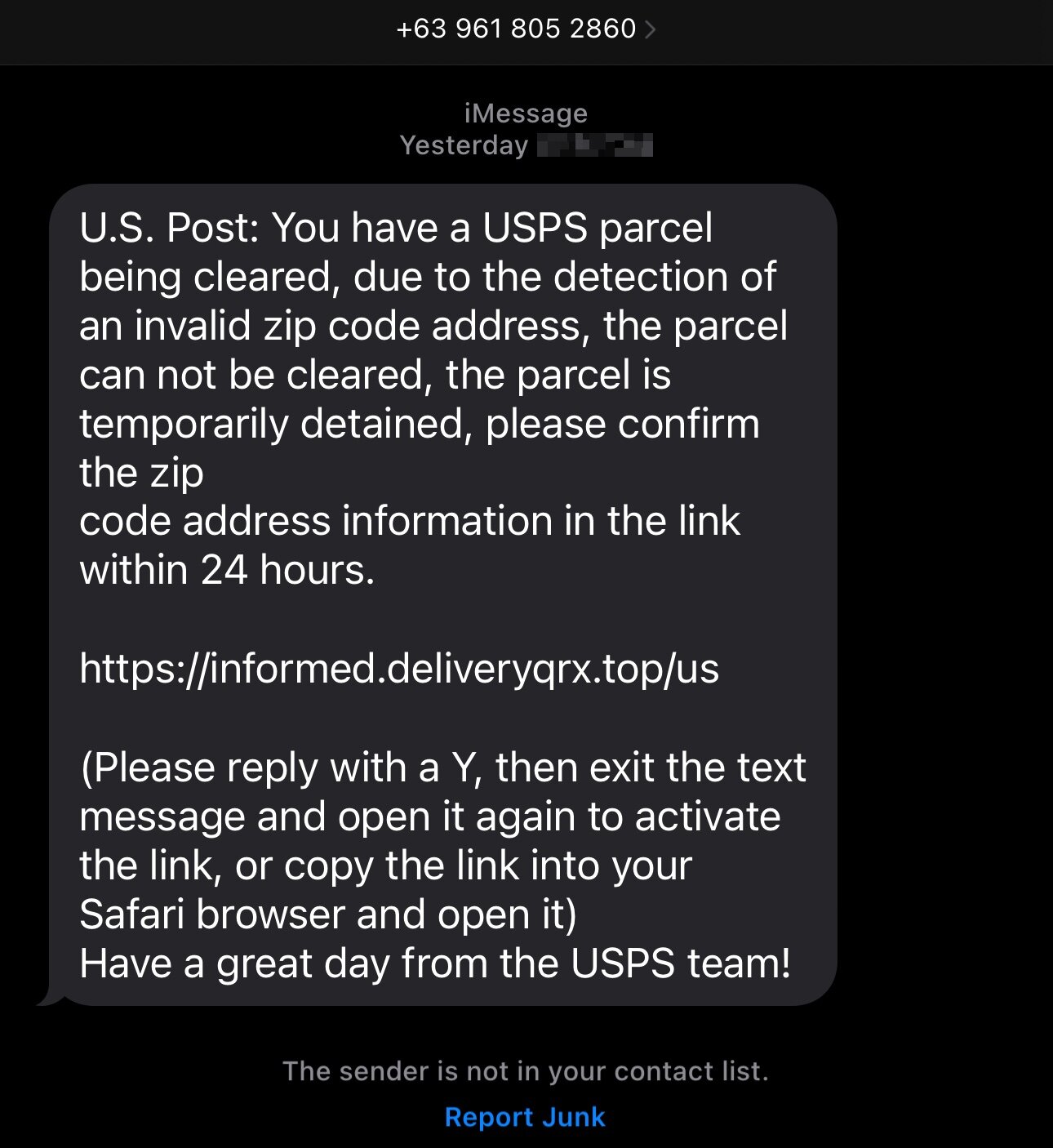
Smishing attempt by a threat actor. Notice the country code from the Philippines.


As you can see, the message—though the country code is from the Philippines—states that there’s an issue with your United States Postal Service (USPS) shipment, and you need to go to a specific link to confirm some information.

In the example above, the link isn’t clickable. But not to worry, the scammers have kindly added helpful instructions. Not only will replying to the message make the link clickable, it will also:

  1. Improve the deliverability rates from this number to other victims
  2. Let the scammers know that your phone number is “live,” likely resulting in you receiving more smishes in the future

In any case, navigating to the link in the message takes us to what looks like a legitimate USPS website.

Huntress Managed SAT

Smishing Simulation

SMS phishing is one of the fastest-growing attack vectors. See exactly how Huntress SAT teaches employees to recognize it—no setup required.
Smishing simulation preview Try the smishing simulation ›


Sites Might Look Legit, but Look Closer 

In any good smish, you’ll be directed to a fake site that, upon an initial glance, might be indistinguishable from the real thing. Case in point, here’s the USPS site we end up on.  
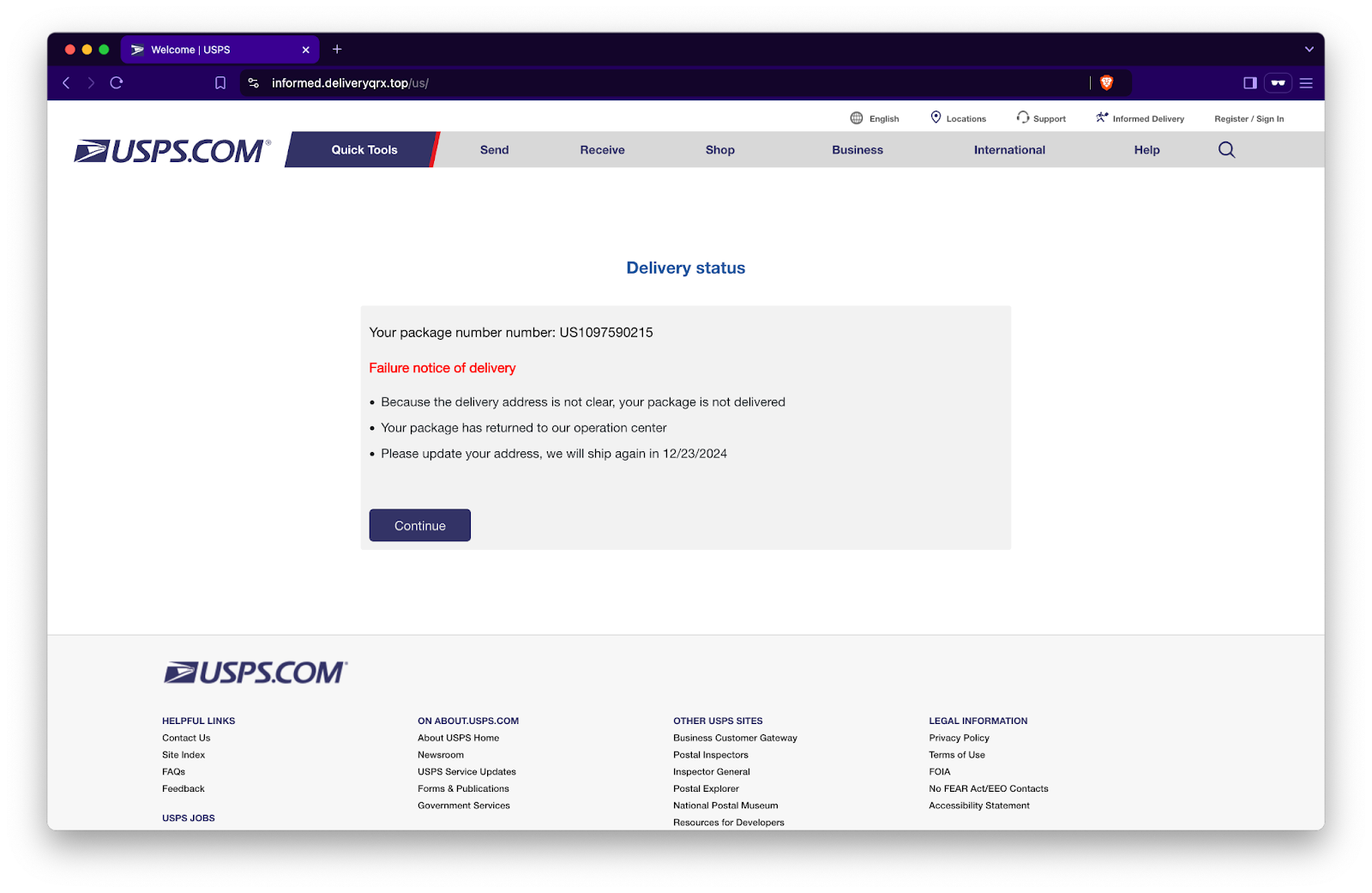
The link in the smish takes us to a seemingly legitimate USPS site.


Ignoring the URL bar, the site we’re directed to looks legitimate. Sure, the message box could be a little more polished and proofread, but as you can see below, the menus work, even leading to real USPS website links.
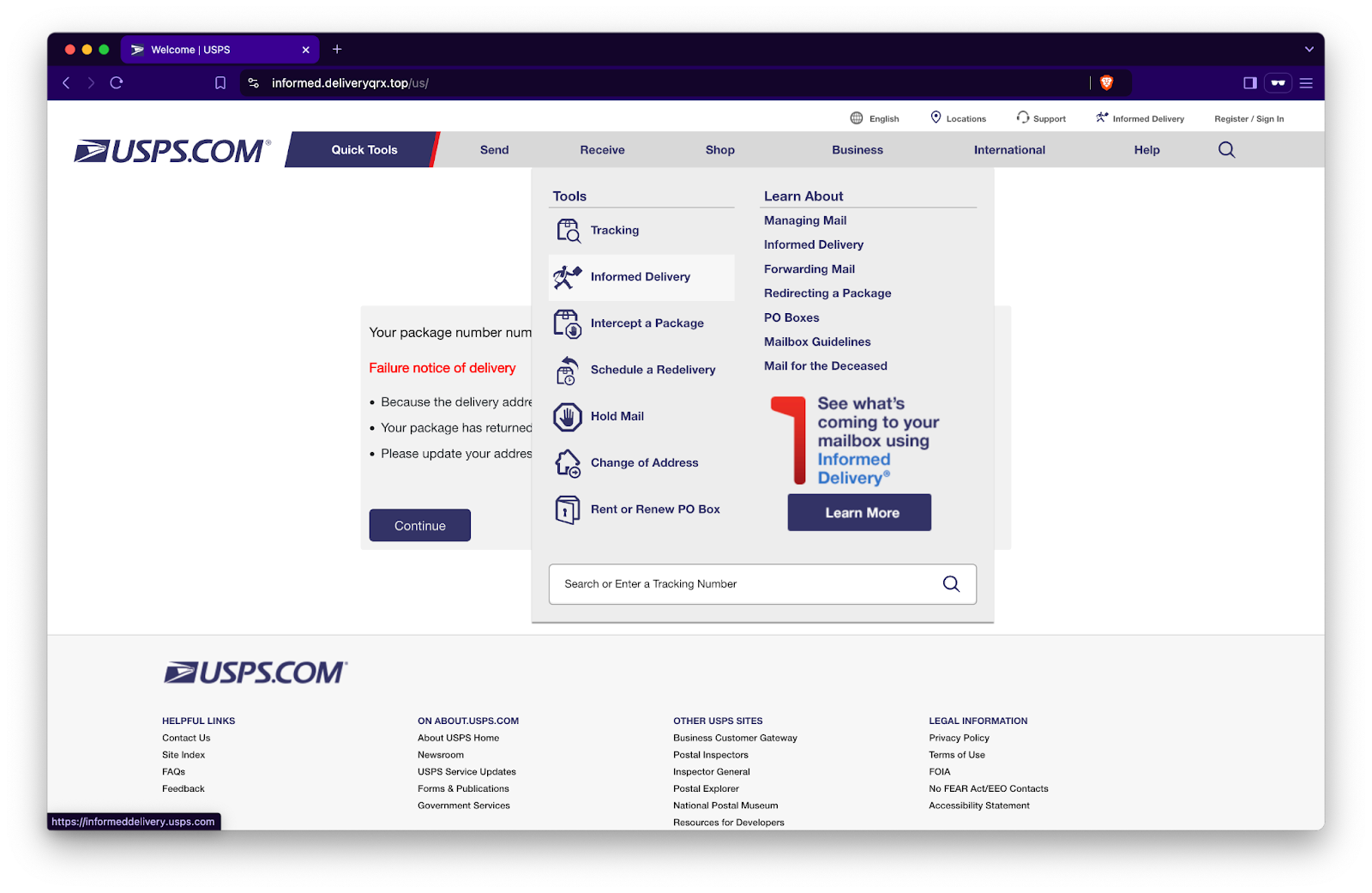
The fake site even has functional menus.


So what happens when we click ”Continue,” blindly trusting that the “package number number” in the "Delivery status” box is our own? Let’s find out.
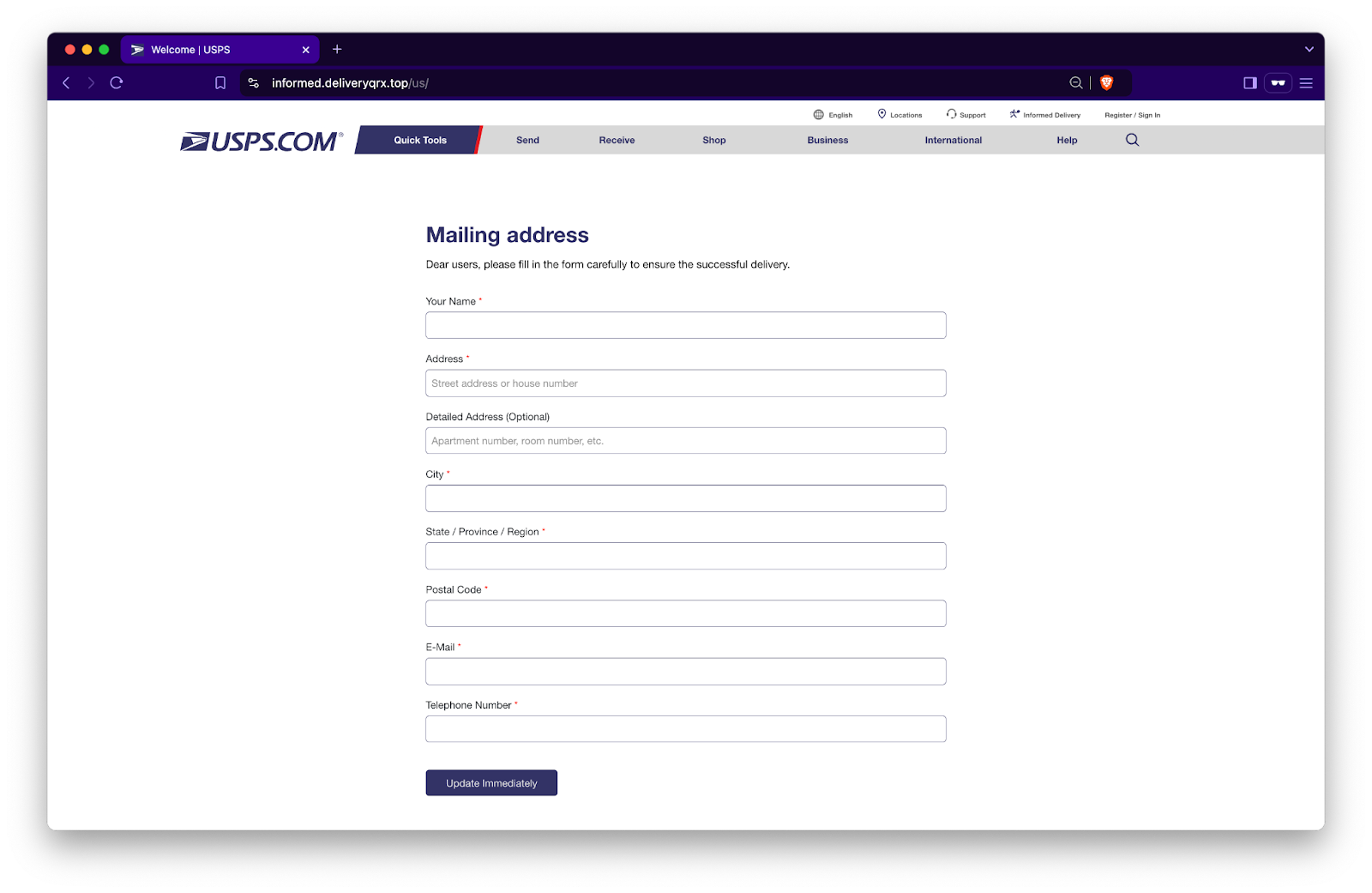
“Mailing address” page for unsuspecting victims to disclose personal info.


You’re asked to input your “Mailing address” and telephone number. Before we proceed, take note of odd language like “dear users” and the inconsistent capitalization in the header compared to other forms of capitalization on the page. These should have your “Spidey senses” tingling. But, let’s suppose the alarm bells aren’t going off just yet, so you continue to enter your information and hit the “Update Immediately” button. What happens next?


How Scammers Score: Getting You to the Payment Page
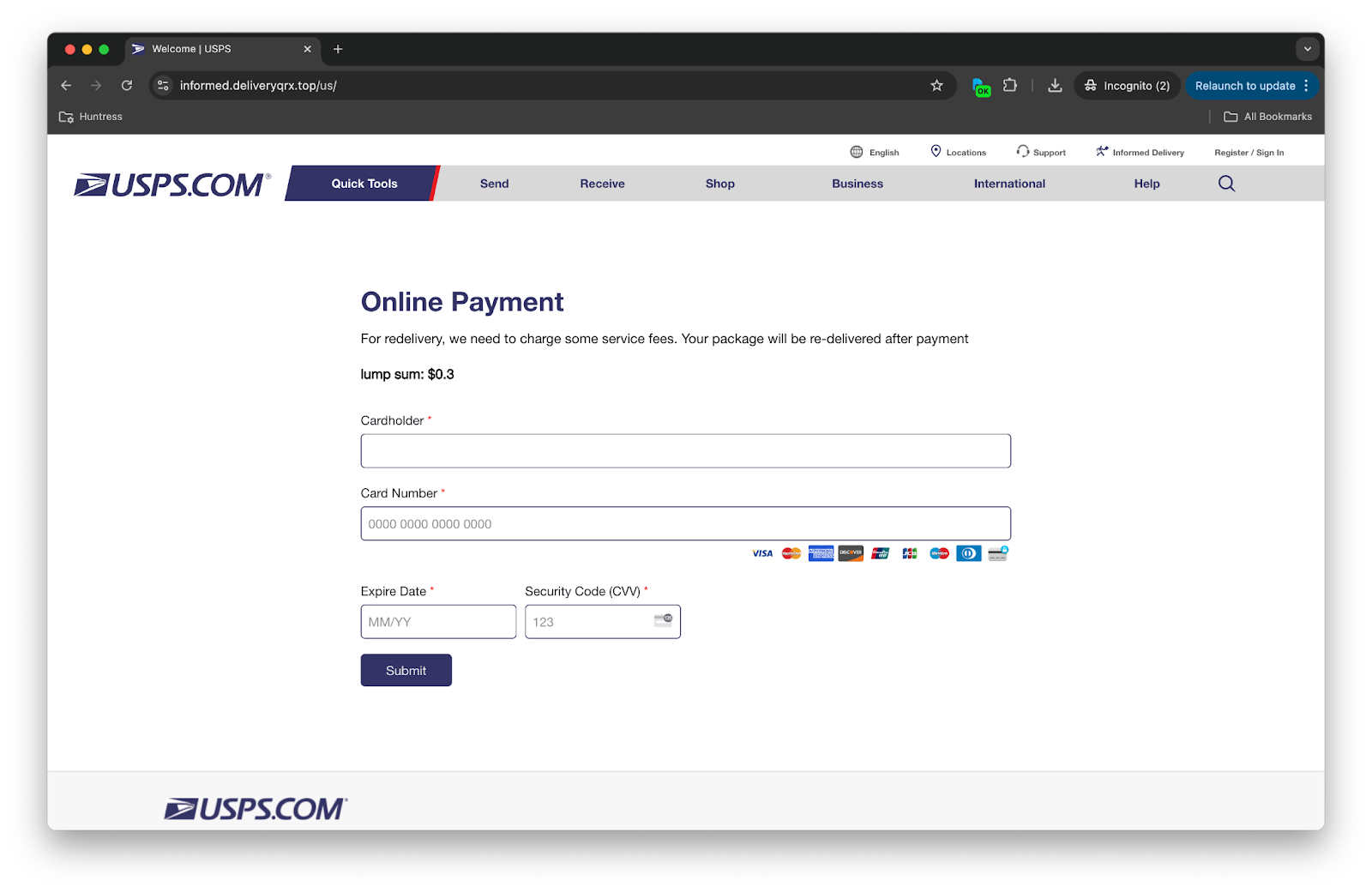
Fraudulent “Online Payment” page. Notice the odd sum of “$0.3”.


As you can see above, you’re now asked to make an online payment—a “lump sum” of just $0.3! This is, allegedly, for the redelivery of your package. But take note of the multiple red flags on this page. When’s the last time you’ve seen something aside from lottery winnings referred to as a “lump sum,” let alone costing 30 cents? Not only that, the “$0.3” leaves off the trailing zero, which is uncommon. Additionally, the second sentence in the description doesn’t have a period like the first one. And the first sentence is simply too casual for USPS: “...we need to charge some service fees.”  

Well, let’s pretend you’re not on top of your game and you just need your mystery package, so you input your payment information and press “Submit.”
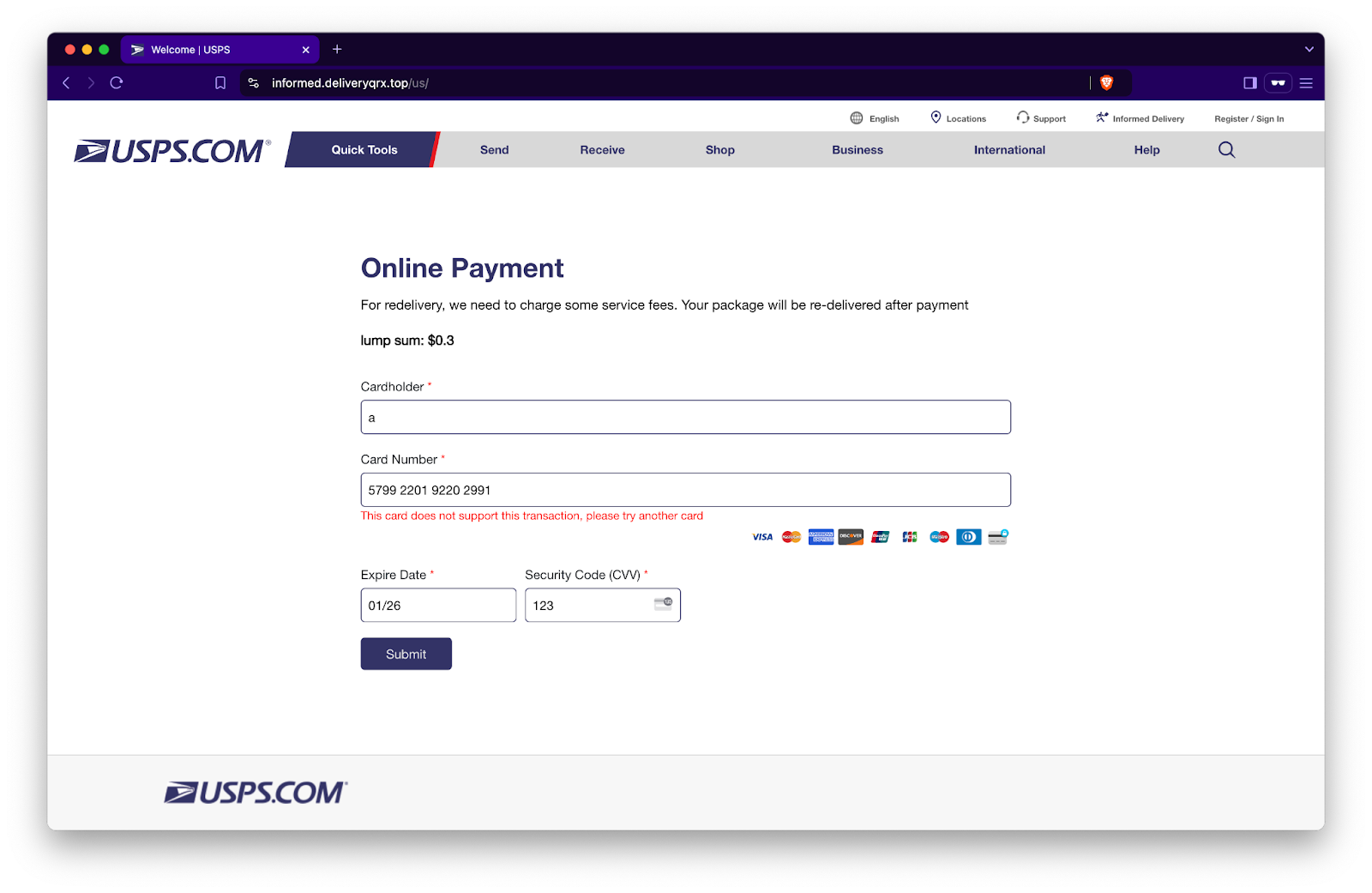
Error messages about your card number are designed to bait you into providing as many payment details as possible.


Your card didn’t work! Luckily, the helpful red error message tells us, “This card does not support this transaction, please try another card.” Hmm, that’s odd because you just used it to buy coffee this morning. After a second attempt, you get the same message. That’s when you follow the instructions and reach for an alternate credit or debit card, fill out the form, and submit it again. But the strangest thing happens—no matter how many cards you try, you keep getting the same error message. Only after trying four cards do you either:

  1. give up and decide to call USPS, or
  2. realize that this is a scam

Unfortunately, whichever option you choose, it’s too late. The scammers already have your billing information and at least one of your card numbers. It’s now a matter of time before they start being used, if not immediately. At this point, the best thing you can do is report your cards as stolen or use some other method of permanently disabling them. You also shouldn’t be surprised if you get even more phishing emails moving forward, as the scammers have the personal information you provided to them.


Why Was This Attack Successful?

There are several reasons this smishing attack is successful. 

  1. Well, it’s the holidays, and you’re probably expecting packages often around this time of year. For that reason, the message was relevant.
  2. If you read that your package is “detained,” along with the time-sensitivity of having only 24 hours to fix the issue, you’re more likely to take action without thinking. The scammers successfully instilled fear and urgency, both of which are very powerful in social engineering attacks.
  3. When you head to the website, it does look legit. Are there things that stand out? Sure. But if you made it this far—past all the red flags in the initial message itself—you’re less likely to spot the red flags on the fake site.
  4. After your first card doesn’t work, you’re likely to try a second or even a third card. Why? Sunk cost fallacy. You’ve already taken all of these steps and you want your package!


How You Can Protect Yourself

The scammers have constructed this attack relatively well, which is probably why it's being seen so often in the wild. The simple truth is it’s working. Not all hope is lost, though—there are ways you can protect yourself from smishing attacks:

  1. Never take action based on a sense of urgency in a message. Always stop and think, especially when you’re being rushed. Remember, you are in control.
  2. Off the top of your head, take your best guess at what the USPS web address could be. Most of you might guess “usps.com,” and guess what, you’d be right. When you see a URL like “informed.deliveryqrx.top” in the original message, alarm bells should be blaring. Even if a link looks legitimate, never click or follow links in messages unless you specifically requested it or are expecting the message. When in doubt, use a secure, verified method of getting to the website you’re looking for, then navigate from there.
  3. Confirm the validity of the issue. In this case, is the tracking number shown on the website tied to one of your shipments? An easier route may be to go to the order history for the recent shopping you’ve done and check for shipping issues on the retailers from which you checked out.
  4. Look out for spelling and/or grammatical errors. This particular example was what you could consider a “good” attack, but there were things that still stood out, which I pointed out throughout this post. Punctuation, terminology, choice of words, and inconsistent capitalization should have given you pause. Trust your instincts.
  5. I’ll start this last point by saying that phone numbers CAN BE spoofed for calls and texts you receive. That means that it’s possible for an attacker to call or text you from (what appears to be) the phone number of their choice. However, in this case, the fact that this message—supposedly from USPS—came from the Philippines, is a massive red flag. To be clear, this doesn’t mean that if you get a text message or call from a phone number you recognize, like that of your bank, you should trust it blindly. You shouldn’t. But that doesn’t mean that you should ignore an obvious red flag either.

Smishing attacks can be tricky, especially when timed strategically by attackers. My best advice is this: most unsolicited messages you receive should be ignored. If, after slowing down, thinking critically, and looking for signs of phishing, you still believe that a message may be legitimate, verify it by navigating to the source on your own. Do not follow links or instructions in the message. 

If you end up in a situation where you realize after the fact that you were phished, take immediate action. In the example we reviewed, you’d want to get your compromised payment cards disabled/reported, and internalize the fact that any personal information you provided may be used against you in future attacks. In the event that you entered your credentials, they’re now compromised and you need to immediately rotate them wherever they’re used. Hopefully, this should only be for one website if you’re following the golden rule of using unique passwords for each site (made much easier with a good password manager). 

Avoiding becoming a victim of social engineering attacks may seem daunting, but if you remain vigilant and aware of how attackers operate, you’ll be just fine. Here’s to a happy, secure new year!  


Categories
Cybersecurity Education
Summarize this postClose Speech Bubble
ChatGPTClaudePerplexityGoogle AI

See Huntress in action

Our platform combines a suite of powerful managed detection and response tools for endpoints and Microsoft 365 identities, science-backed security awareness training, and the expertise of our 24/7 Security Operations Center (SOC).

Book a Demo
Share
Facebook iconTwitter X iconLinkedin iconDownload icon
Glitch effect

You Might Also Like

  • Protect Yourself from Political Donation Scams

    Don’t let fraud disrupt your civic duty. Learn how to spot and avoid political donation scams that target voters through robocalls, fake websites, and deepfakes.
  • Five Shady Phishing Email Techniques We Spotted in 2025

    From fake UPS shipping notifications to PayPal-themed callback phishing, here are the five top phishing techniques we’re seeing this year.
  • 5 Phishing Email Scams and How NOT To Fall For Them

    Explore the art of phishing, learn how to spot common phishing scams and red flags, and understand the importance of security awareness training.
  • How a College Student Lost $10,000 to “The IRS”

    In this testimonial, learn firsthand from one of our Security Awareness Consultants at Curricula about how a fake IRS phishing scam worked on one student.
  • Don't Get Played: How to Identify Recruiting Scams and How Huntress Is Fighting Back

    Recruitment scams are on the rise. Learn how to identify common scams and discover how Huntress is actively working to protect job seekers from fraudulent offers and identity theft.
  • A Survivor’s Journey Through the Cybercrime Underground

    From an IT job to forced underground cybercrime, Mohammad’s story exposes the global trafficking network behind massive crypto scams. Learn the signs to stay safe.
  • Don’t Get Schooled: How to Catch a Phish

    This blog explores phishing and smishing, diving into how to analyze text messages for their validity and legitimacy.
  • Teach Yourself to Phish: The Strategy Behind Phishing Simulations

    Get ready for a phishing trip! Learn about the strategy behind phishing simulations and how it can help your organization build resilience against real phishing threats.

Sign Up for Huntress Updates

Get insider access to Huntress tradecraft, killer events, and the freshest blog updates.
Privacy • Terms
By submitting this form, you accept our Terms of Service & Privacy Policy
Thank you! Your submission has been received!
Oops! Something went wrong while submitting the form.
Huntress Managed Security PlatformManaged EDRManaged EDR for macOSManaged EDR for LinuxManaged ITDRManaged SIEMManaged Security Awareness TrainingManaged ISPMManaged ESPMBook a Demo
PhishingComplianceBusiness Email CompromiseEducationFinanceHealthcareManufacturingState & Local Government
Managed Service ProvidersResellersIT & Security Teams24/7 SOCCase Studies
BlogResource CenterCybersecurity 101Upcoming EventsSupport Documentation
Our CompanyLeadershipNews & PressCareersContact Us
Huntress white logo

Protecting 215k+ customers like you with enterprise-grade protection.

Privacy PolicyCookie PolicyTerms of UseCookie Consent
Linkedin iconTwitter X iconYouTube iconInstagram icon
© 2025 Huntress All Rights Reserved.

Join the Hunt

Get insider access to Huntress tradecraft, killer events, and the freshest blog updates.

By submitting this form, you accept our Terms of Service & Privacy Policy